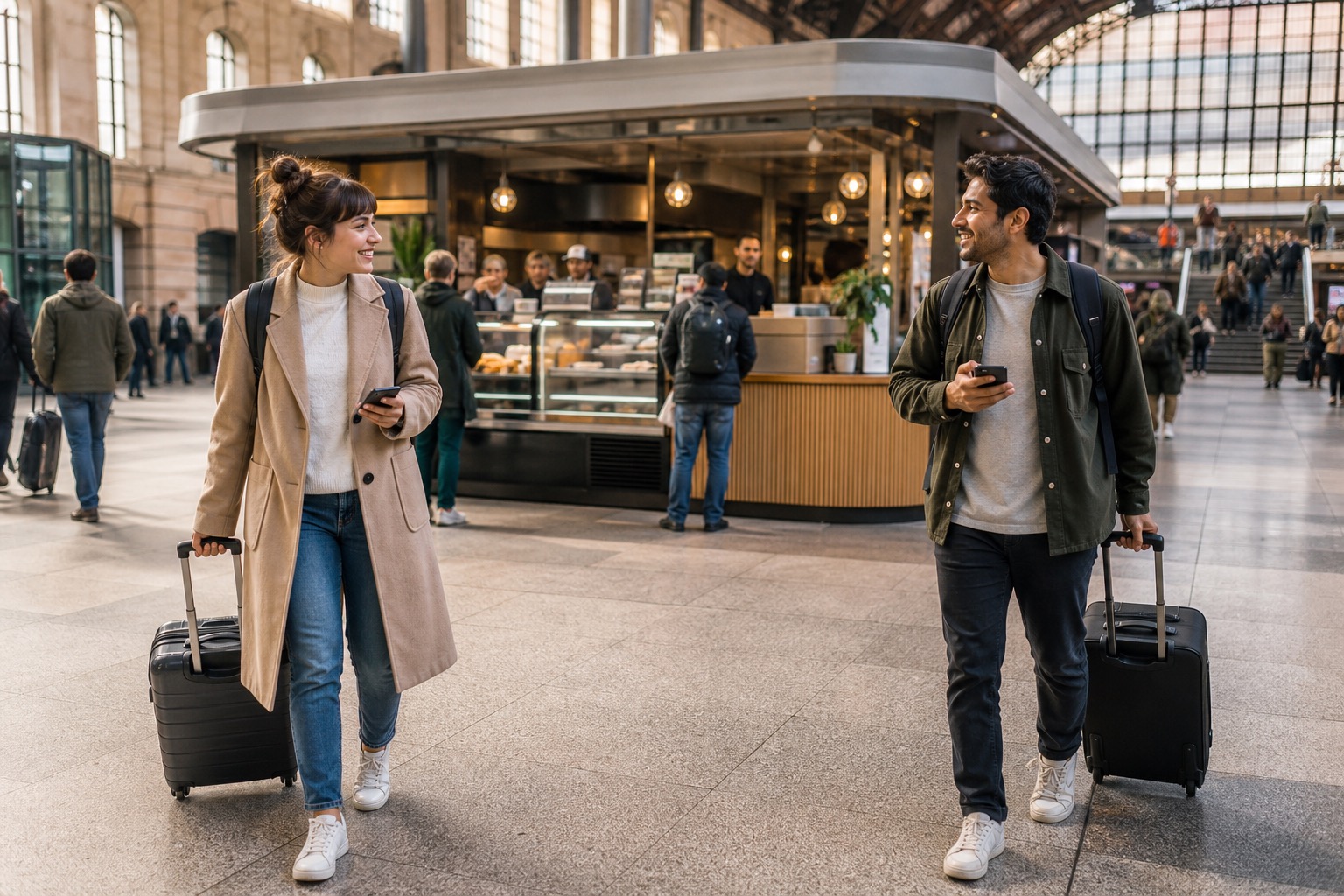
Your Next Adventure Could Change Everything
Join thousands of adventurous women who've discovered that the best travel stories often include a plot twist.
Start Your Adventure – Join Free
✓ Free to join ✓ No credit card required ✓ Join 50,000+ travelers
A travel date meeting point is not just the pin halfway between two people. It is the place where route, timing, luggage, phone service, visibility, budget, and independent exits all work at once. For a solo traveler, the prettiest venue can be the wrong choice if it requires a private ride, closes before the date ends, sits beyond the last train, or reveals an accommodation address. The better plan makes connection possible without handing control of the trip to someone new.
Gallivanta’s travel-first rule fits this decision: adventure first, sparks welcome, traveler control intact. Choose a place both travelers can reach and leave under their own power. Set a short first window. Keep bags, lodging, and onward plans separate. A fair meeting point is not always exactly equal in distance; it is fair when neither person must absorb hidden risk, cost, or logistical pressure.
Published and reviewed: August 17, 2026
- → What makes a travel date meeting point fair
- → Build the meeting point from both routes
- → Score public visibility and control
- → Protect luggage, lodging, and personal information
- → Plan data, battery, and a no-signal fallback
- → Protect the rest of the trip
- → Use a stronger frame for higher-risk travelers
- → Scripts for proposing the meeting point
- → Travel date meeting point checklist
- → Sources and review boundaries
- → FAQ: Travel date meeting point
What makes a travel date meeting point fair
Fairness begins with the whole journey, not the map’s midpoint. One traveler may be walking from a central hostel with a light daypack while the other is arriving from an airport with a suitcase, an unfamiliar transit card, and limited data. Sending both people twelve minutes toward the geometric center does not make those trips equivalent. Compare transfers, walking after dark, stairs, luggage, ticket cost, service frequency, and the route home.
A good first meeting point has five qualities. It is public and staffed. It is easy to name precisely. It works for a short visit without a reservation or large prepayment. It has at least two practical onward routes. It does not require either person to disclose a room, home, or exact lodging address. A main-station cafe, museum foyer with public hours, busy market hall, or well-trafficked hotel lobby not connected to either person’s room can work. A platform edge, parking structure, quiet riverside path, private apartment, or “I’ll pick you up” arrangement is a weaker default.
Use Gallivanta’s travel dating app built around routes and intent to state the useful context early: the neighborhood you can reach, your available window, whether you have luggage, and whether the meeting is social or romantic. That is more actionable than sending a live location and hoping the other person improvises well.
Illustrative scenario: Maya, 31, reaches Lisbon after a morning bus and has a roller bag until her 15:00 check-in. Tomas suggests a scenic miradouro halfway between them. Maya checks the hills, cobblestones, and lack of staffed indoor space, then proposes a public food hall near a metro interchange for 45 minutes. They meet, pay separately, and Maya takes one direct train toward her lodging. The concrete outcome is a relaxed first conversation without dragging luggage uphill or revealing her hotel.
Build the travel date meeting point from both routes
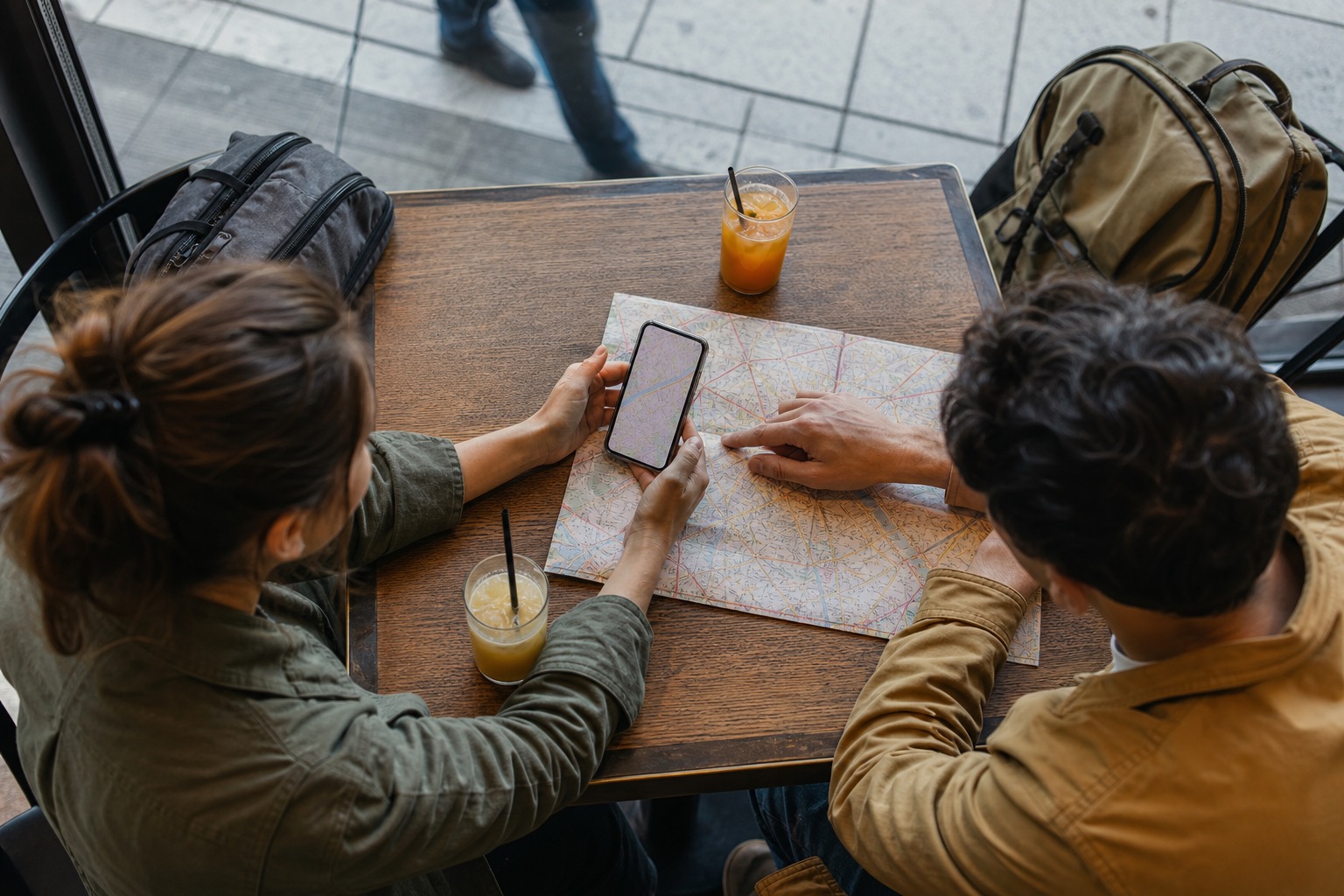
Ask each traveler to map three legs: where they start, how they reach the venue, and how they leave. The exit leg matters most. A venue with a simple inbound route but a 25-minute wait on an empty platform afterward is not balanced. Neither is a place that leaves one person dependent on the other’s car, local-language skill, transit account, or phone battery.
Compare routes at the actual meeting time. A line that runs every six minutes at noon may switch to a 30-minute schedule at night. Station entrances can close even while trains continue. Street markets and museum cafes may shut early. Construction can move bus stops. Accessibility routes may use a different entrance. Check the relevant transit operator and venue on the day, and save a screenshot of the final public location.
Use a simple burden test. Count transfers, walking minutes, stairs or inaccessible segments, expected fare, last dependable departure, and exposure after dark. If one route is clearly harder, move the venue toward that traveler or shorten the date so the return remains easy. Fairness can also mean the more locally confident person travels farther while the newcomer stays near a major public hub.
For broader route-aware connection, Gallivanta’s guide to meeting travelers while keeping your own itinerary helps separate genuine overlap from forced detours. The aim is not to make two trips identical. It is to stop unspoken travel friction from turning into social pressure.
Score the venue for public visibility and control

Public does not automatically mean useful. A large park can be technically public but poorly lit, hard to describe, and empty after sunset. A station can be busy but contain isolated corridors and multiple similarly named exits. Score the exact venue, not the neighborhood label. Look for staff, steady foot traffic, clear lighting, indoor seating, visible exits, restrooms, and a service counter where someone could ask for help.
Choose a named landmark and a precise zone: “inside the east entrance, at the cafe beside the staffed information desk” is better than “near Central Station.” Confirm whether the venue is before or after ticket barriers. If either traveler has luggage, make sure bags can stay within reach without blocking an aisle. If the venue requires a reservation, deposit, dress code, or fixed tasting menu, it is a poor first-plan default because leaving becomes socially and financially harder.
Create a same-zone fallback. If the cafe is full, meet at the staffed information desk twenty meters away rather than wandering the district while exchanging messages. Set a ten-minute waiting rule. When one person cannot arrive or communicate within that window, cancel and continue the trip. That rule protects both people from chasing a moving pin.
For more first-meeting structure, use Gallivanta’s public-first travel date framework and first travel date planning guide. They support the same principle: the first location should make leaving ordinary, not dramatic.
Protect luggage, lodging, and personal information
Keep passports, medication, wallets, keys, and phones on your body or in a bag you control. Do not ask someone you have just met to watch luggage while you use a restroom, buy a ticket, or check in. Do not store a bag in their car or room. If you need a locker, use an official station, airport, or staffed commercial service whose hours and access rules you have verified.
Your accommodation does not need to become the meeting point. A hostel common room may feel public while still revealing where you sleep and how to enter the building. A hotel lobby tied to your reservation can expose the property and invite a request to “just go upstairs.” Meet at a neutral public hub, and share a broad neighborhood only when it helps route planning. The exact hotel, room number, apartment entry code, and the fact that you are staying alone are not coordination requirements.
Share the minimum useful travel context. A first name, public meeting point, arrival estimate, and cancellation rule are enough for many plans. Do not send a passport image, boarding pass, booking reference, full itinerary, key-card photo, or screenshot containing personal notifications. If a person insists that those details are necessary, move the conversation back to the public plan or cancel.
Before departure, Gallivanta’s solo travel dating safety plan can help separate trusted-contact preparation from the details shared with a new match. The meeting point should reveal only what is needed for the public plan.
The U.S. State Department’s international travel checklist recommends making copies of important documents and leaving a set with a trusted friend or relative. That guidance supports preparation with a trusted contact; it is not a reason to share documents with a new match. Keep the trusted-contact layer separate from the dating layer.
Plan data, battery, and a no-signal fallback
The meeting should survive a weak connection. Before leaving Wi-Fi, save the venue name, address, entrance, transit route, return route, and a screenshot of the public meeting pin. Download the relevant map area when the feature is available. Google’s official offline Maps guidance notes an important limit: offline driving navigation may work within a downloaded area, but transit, cycling, and walking directions are unavailable offline. Save the specific public-transit steps separately instead of assuming an offline map will rebuild them.
Check roaming or eSIM coverage before the meeting, especially when crossing a border or using a transit country. The State Department’s current communication guidance for travelers recommends confirming international service, considering local SIM or eSIM options, saving important contacts, and keeping a backup communication method. Adapt that to the date: know how to reach local emergency services and your lodging without depending on the person you are meeting.
Set a no-signal protocol in advance: both people go to the exact landmark, wait ten minutes, and then leave. Do not roam through unfamiliar streets trying to recover contact. Keep enough battery for transit tickets, maps, authentication, airline or rail updates, and an emergency call. A power bank can help when permitted by the relevant transport rules, but it does not replace a saved route.
Public Wi-Fi can be useful for coordination. The U.S. Federal Trade Commission explains that encrypted websites have improved the safety of public Wi-Fi, while still recommending current software and attention to how personal information is protected. Read the FTC’s public Wi-Fi guidance and avoid treating a cafe network as the only link between you and the rest of the trip.
Set a time budget that protects the rest of the trip
A first travel meetup needs a beginning, an end, and a protected onward buffer. Start from the next fixed obligation—check-in window, train, flight, tour, medication time, work call, or last dependable transit—and work backward. Subtract the full route from the venue, ticket or security tasks, luggage collection, accessibility needs, and a disruption margin. Only the remaining window belongs to the date.
Forty-five to ninety minutes is often enough for a first public meeting, but this is a planning range, not a universal safety rule. Choose the duration that fits the actual route. Set two alarms: one to close the conversation and one to physically leave. When the second alarm sounds, go. The person you are meeting does not own the consequences of a missed train, locked hostel desk, or exhausted workday.
Budget money as well as time. Decide what you are willing to spend on fares, food, luggage storage, and an independent ride if regular transit fails. A simple cafe or market-hall plan makes separate payment and an early exit ordinary. Avoid nonrefundable tours, distant restaurants, or tickets purchased by the other person before you have agreed to them.
Gallivanta’s solo travel dating approach works best when connection fits the journey instead of replacing it. If the available window becomes short, move the meeting closer, shorten it, or reschedule. Canceling because the route changed is not a failed date. It is competent travel.
Loving This Travel Dating Safety? Don't Explore It Alone.
Real Gallivanta members are planning trips to Travel Dating Safety right now. Join the community and turn your solo travel dreams into shared adventures.
Join Gallivanta FreeUse a two-exit rule for the travel date meeting point
The first exit is your ordinary planned route: a well-lit walk to transit, a staffed taxi rank, a rideshare you order yourself where lawful and appropriate, or a direct path back to a terminal. The second is a fallback you can activate without help from the other person. That may be another transit line, the venue’s staffed desk, a licensed taxi queue, or a nearby open business where you can wait while arranging transport.
Check both exits before the meeting starts. Know the final service you are willing to take, not merely the absolute last service. A 23:58 train may technically exist but leave no recovery option if it is canceled. Keep the venue within a route you understand and can pay for. If the second exit depends on the other person’s car, home, account, or promise, it is not independent.
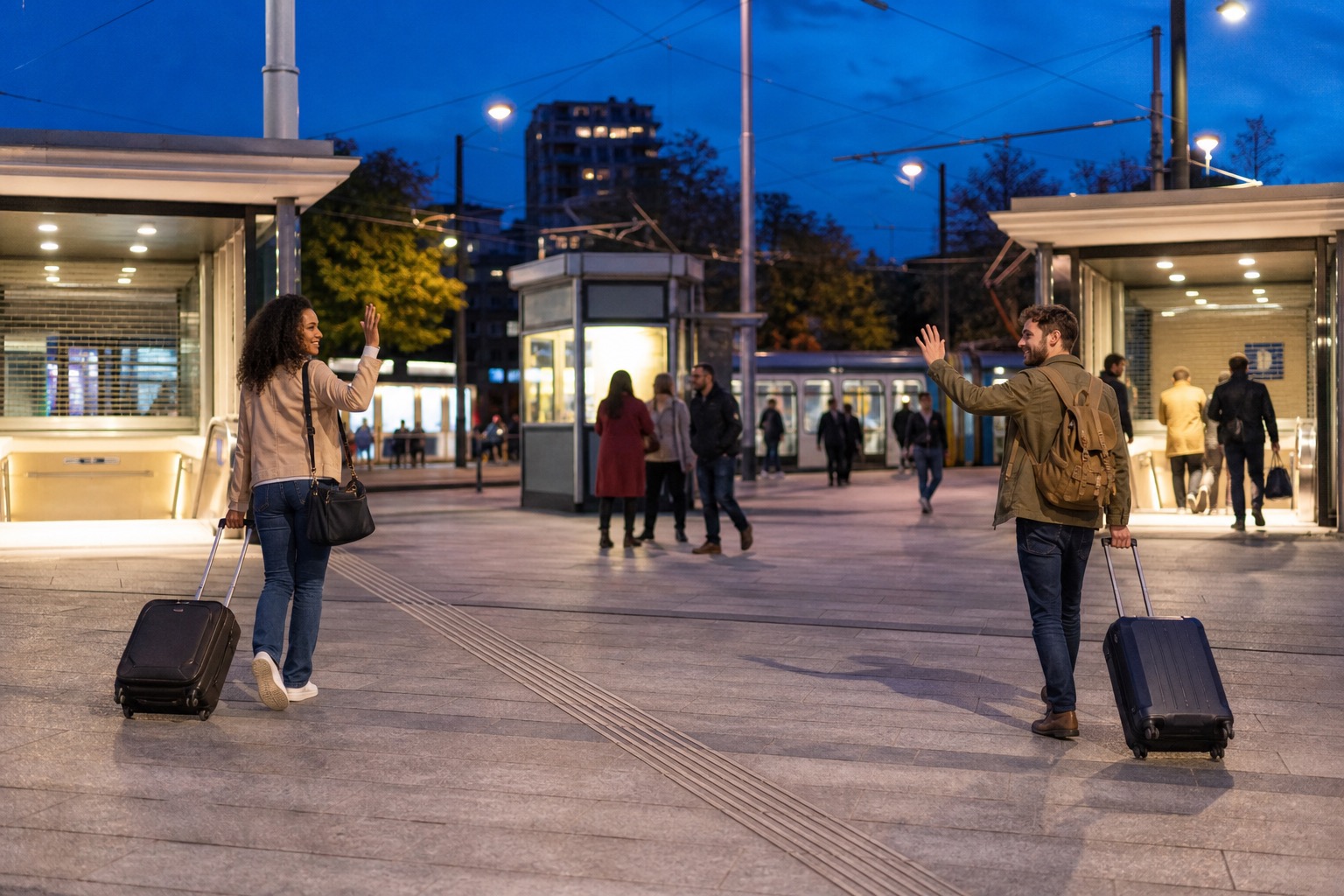
If the conversation is going well, future plans are better than surrendering the exit buffer. Say, “I need to catch my train, but I would like to continue this tomorrow.” Gallivanta’s travel meetup exit strategy offers language for ending warmly, while the route remains non-negotiable.
Women and higher-risk travelers need a stronger frame
Women, LGBTQ travelers, disabled travelers, travelers facing racism or xenophobia, people with visible valuables, and anyone navigating a destination where identity or mobility increases risk should strengthen the default plan. Choose a staffed indoor venue with accessible routes and steady foot traffic. Meet earlier. Keep the first window short and sober. Maintain your own transport, money, data, documents, and accommodation privacy.
Tell a trusted person the public venue, expected end time, and what action to take if you miss a check-in. Apple’s Check In safety guide explains that compatible iPhones can notify a trusted contact when a traveler arrives and can use a timer-based check-in; feature availability and shared details vary. Use a tool only after understanding what it shares, and share with someone you trust—not automatically with the person you are meeting.
Accessibility is not spare time. Step-free entrances, lifts, platform assistance, quiet breaks, medication, restroom access, and boarding support belong inside the protected route budget. A venue labeled accessible may still have a broken lift or a long alternative entrance. Confirm the route with the relevant operator or venue, then keep the contingency margin.
Pressure is useful information. Cancel if someone insists on your hotel, offers no public alternative, changes the location toward a private space, pushes alcohol, mocks a check-in, argues about the time limit, or tries to control the ride home. Gallivanta’s guide to dating safely as a solo female traveler goes deeper on boundaries for women, while these route-control principles can help any higher-risk traveler.
Illustrative scenario: Samira, 34, is in Mexico City for a conference and has a free early evening. Her match proposes a rooftop close to his apartment, requiring two transfers and a ten-minute walk after dark. Samira chooses a staffed cafe inside a major shopping and transit complex on her direct line, tells a friend the end time, and schedules a timer check-in. When the match keeps asking which hotel she is using, she cancels before leaving. The concrete outcome is not a missed opportunity; it is a boundary tested before exposure.
Adjust the plan for airports, stations, hostels, and road trips
At airports, confirm whether the venue is landside or airside, which terminal it uses, and whether both people can legally access it. Protect immigration, baggage, security, and boarding time. Gallivanta’s long layover meetup plan covers that special case in detail.
At rail and bus stations, avoid platform-only plans because ticket barriers, track changes, and similarly named exits create confusion. Meet near a staffed information point or public cafe before barriers. Keep bags controlled and check the last dependable onward service. If the station empties late, move the meeting earlier or to a busier connected venue.
At hostels, do not use your bed, room, property entrance, or quiet common area as the first location. Pick a neutral cafe or market nearby without identifying where you sleep. On a road trip, do not build the first meeting around getting into one vehicle. Meet in a staffed public place with separate parking and separate onward routes, and keep fuel, keys, luggage, and lodging under your control.
Illustrative scenario: Devon, 27, is traveling through Kyoto by rail with a daypack and an evening reservation across town. His match suggests meeting outside an attraction reached by a bus that runs infrequently after 20:00. Devon proposes a station-adjacent museum cafe near two rail lines and sets a 70-minute window. A service disruption begins during the date, so he uses the second line and reaches his reservation. The concrete outcome comes from choosing route redundancy before chemistry entered the calculation.
Scripts for proposing a travel date meeting point
A useful proposal names the place, public frame, time window, and independent route. Try: “I can meet from 17:30 to 18:30 at the staffed cafe inside the east entrance of Central Station. It is on both our lines, and I need to leave at 18:30 for my check-in.” That sounds interested because it is specific. It also removes the ambiguity that causes last-minute drift.
When the midpoint is unfair, say: “The map midpoint gives me two transfers with luggage. Could we use the market hall by River Station instead? It gives both of us a direct route.” When someone offers a ride: “Thank you, but I keep first travel meetups on public transit and arrive separately.” When the venue changes toward private space: “I am only available for the public plan we agreed. If that no longer works, let’s reschedule.”
For phone failure: “If messages stop, meet at the staffed information desk, wait ten minutes, and then continue your day.” For an ending: “I am heading to my train now. I enjoyed this and would be open to another plan.” For a route disruption: “My return line changed, so I am leaving now rather than using the buffer.”
Good scripts reduce negotiation at the moment of pressure. Gallivanta’s solo travel conversation starters can help the meeting itself feel natural, but the logistics should already be settled before either traveler arrives.
Travel date meeting point checklist
Run this checklist before sharing the final pin and again before leaving for the venue. If any flight-, train-, lodging-, accessibility-, or safety-critical answer changes, move, shorten, or cancel the plan.
- Exact place: Is the venue named, public, staffed, open, and easy to identify?
- Access: Is it before or after ticket barriers, security, or immigration, and can both people reach it?
- Inbound route: Can each traveler arrive without depending on the other person’s car, account, or instructions?
- Outbound route: Does each traveler control a safe primary exit and a separate fallback?
- Timing: Is there a fixed end time plus a protected buffer before the next obligation?
- Transit: Have both people checked actual service frequency, transfers, closures, and the last dependable departure?
- Accessibility: Are step-free routes, assistance, sensory breaks, medication, and restroom needs protected?
- Luggage: Can every bag, document, key, wallet, and medication remain under its owner’s control?
- Privacy: Does the plan avoid room numbers, entry codes, exact lodging, full itineraries, and document images?
- Data: Are the venue, route, and fallback saved for weak service or no signal?
- Battery: Is there enough charge for tickets, maps, transport updates, authentication, and emergency contact?
- Money: Can each traveler pay for the meeting and their independent exit?
- Trusted contact: When appropriate, does someone trusted know the public venue and check-in time?
- Fallback: Is the no-signal, late-arrival, full-venue, or transit-disruption rule already agreed?
- Consent: Does either person accept “no,” a public boundary, and a fixed departure without argument?
If the venue passes only because one traveler promises to solve every problem, it does not pass. If a route works only while a phone has perfect service, it does not pass. If leaving would cause guilt, financial loss, or dependence, simplify the plan. The best travel date meeting point makes a genuine yes easier and a clean no ordinary.
Sources and review boundaries
This guide uses current official guidance from the U.S. State Department’s international traveler checklist and communication guidance, Google Maps offline map documentation, Apple’s Messages Check In documentation, and the FTC’s public Wi-Fi advice. They support the document preparation, communication, offline navigation, trusted-contact, and network considerations described above.
Transit schedules, station access, venue hours, local laws, emergency numbers, map features, and device tools can change. This article is general planning and safety advice, not legal, medical, transport-operator, or emergency authorization. Verify the relevant destination, carrier, transit operator, venue, and device documentation for the date of travel. The named traveler examples are invented composites labeled “Illustrative scenario”; they are not testimonials, customer stories, or firsthand reports.
FAQ: Travel date meeting point
What is the safest travel date meeting point?
Choose a staffed, well-lit, public venue with steady foot traffic, a precise landmark, working hours, and two independent exit options. The safest choice depends on the actual city, time, route, identity, mobility needs, and current conditions, so verify locally.
Should a travel date meeting point be exactly halfway?
Not necessarily. Compare transfers, walking, luggage, accessibility, cost, service frequency, and the route home. A fair point minimizes hidden burden and dependence, even when one person travels farther in distance.
Should I meet a travel match at my hotel or hostel?
Use a neutral public venue for a first meeting. A hotel or hostel can reveal where you sleep, building access, or that you are staying alone. If using a hotel lobby, choose one unrelated to either person’s room and keep the plan public.
What should we do if phone service fails?
Agree on one exact staffed landmark, save the address and route offline, wait for a fixed short period such as ten minutes, and then cancel. Do not wander through an unfamiliar area chasing a moving location.
How long should a first travel date last?
Choose a window that protects the next fixed obligation and both independent exits. Forty-five to ninety minutes can be practical for many first meetings, but the route, schedule, accessibility needs, and energy level should decide the actual duration.
Should I share my live location with the person I am meeting?
You do not need continuous location sharing to coordinate a public meeting. A static public pin and arrival estimate are often enough. If a trusted-contact check-in helps, understand the tool’s data sharing and use it with someone you trust.

Fact-checked | Safety reviewed | Updated August 17, 2026
Ready to Meet Your Next Travel Date?
You've got the destination, the vibe, and the courage to go solo. Now all you need is someone who gets it. Join Gallivanta and meet fellow travelers who believe the best chapters start with a one-way ticket.
Join Gallivanta Free