Your Next Adventure Could Change Everything
Join thousands of adventurous women who've discovered that the best travel stories often include a plot twist.
Start Your Adventure – Join Free
✓ Free to join ✓ No credit card required ✓ Join 50,000+ travelers
A travel date verification checklist helps a solo traveler test whether a new match’s identity, photos, story, timing, and proposed meetup are reasonably consistent before meeting in person. It cannot certify that somebody is safe, honest, single, kind, or compatible. Its real job is narrower: find contradictions early, protect private trip information, and decide whether the connection has earned a short meeting in a staffed public place.
Gallivanta’s travel-first position is adventure first, sparks welcome, traveler control intact. Verification should support that control, not turn a promising conversation into surveillance or an amateur investigation. Ask only for what you genuinely need, offer the same level of ordinary context in return, and treat pressure, secrecy, money requests, or hostility toward boundaries as reasons to stop.
Published and reviewed: August 28, 2026
- → Set the limits of verification
- → Start with small consistency checks
- → Cross-check profile photos
- → Use a short video call
- → Test the travel story against logistics
- → Protect money and private trip data
- → Build the public meeting plan
- → Strengthen the plan for higher-risk travelers
- → Recognize stop signals
- → Use proportionate scripts
- → Run the action checklist
- → Review sources and boundaries
- → Read the FAQ
What a travel date verification checklist can—and cannot—prove
Verification is a set of friction tests. Does the person answer ordinary questions consistently? Do their photos appear under a different name? Will they take a brief live call without demanding private access from you? Does the proposed venue match the city, opening hours, transit pattern, and time they describe? One consistent answer is not proof. Several unexplained contradictions are useful information.
Keep four decisions separate. Identity asks whether the person appears to be the same adult represented in the profile. Intent asks whether they want the kind of meeting you discussed. Logistics asks whether the city, route, timing, venue, budget, and departure plan make sense. Safety asks whether their behavior respects consent, privacy, and your ability to leave. A photo check can contribute to identity; it says little about intent or conduct.
The distinction matters because scammers and unsafe people can pass a single test. A current video call can still be manipulated. A real social account can belong to a person who ignores boundaries. A verified badge may reflect only the platform’s stated process, which can differ by service and change over time. Australia’s eSafety Commissioner advises travelers to examine the safety features a service offers, including whether it provides photo or identity verification, while still protecting personal information and using the platform’s reporting tools. Pair those checks with Gallivanta’s broader solo travel dating safety plan before departure.
Use the checklist to decide among three outcomes: continue talking, propose a bounded public meeting, or stop. Do not use it to justify a private first meetup because “everything checked out.” Gallivanta’s guide to travel dating safety without killing the spark treats verification as one layer alongside public places, independent transport, check-ins, and personal boundaries.
Reciprocity should be proportionate. You can offer a brief live call because you requested one. You do not owe a passport scan, booking confirmation, employer contact, room number, home address, or full itinerary. A reasonable person can understand the difference between confirming “I am the person in this profile and I am currently in Porto” and proving every detail of your identity to a stranger.
Start with small identity consistency checks
Begin inside the service where you matched. Read the full profile again after the first burst of conversation. Note the claimed first name, approximate age, current city, trip purpose, languages, route, and timing. You are looking for stable context, not a dossier. People make typos, change plans, and describe neighborhoods loosely; ask once before treating a mismatch as deception.
Use questions that a genuine traveler can answer without disclosing sensitive information. “Which station area works for you after check-in?” is better than “Send your hotel confirmation.” “Are you here through Tuesday or leaving Tuesday morning?” is better than asking for a boarding pass. Ask how the date fits around real constraints: arrival fatigue, luggage, work calls, a tour, last transit, or an early departure.
Consistency across time is more valuable than volume. A profile says the person is on a weeklong food trip, the conversation mentions a cooking class, and the proposed cafe sits near the neighborhood they previously named. That is ordinary alignment. A profile says they are already in town, but every public meeting becomes impossible while urgent requests for transport money appear. That pattern deserves a stop, not another round of persuasion.
Keep early messages on the original dating or connection platform when practical. RAINN’s current safer-dating guidance warns against pressure to move off-platform too soon because dating services may provide protections and reporting tools that ordinary messaging channels do not. eSafety makes a similar point: moving to another service can remove some platform safety features. This is not a guarantee that the app is safe; it preserves an available reporting trail while you evaluate the match.
Illustrative scenario: Maya, 31, lands in Porto on a Friday afternoon for a five-night remote-work stay. Her match says he is in the city for a design conference through Sunday. When Maya asks whether Saturday at 16:00 near Trindade works, he explains that his conference ends at 15:00 and suggests a staffed cafe beside the station. The timing, public venue, and earlier trip details remain consistent. Maya’s concrete decision is to offer a 60-minute coffee, not to treat consistency as permission for a private evening.
Cross-check photos without playing detective
A reverse-image search asks whether a profile photo appears elsewhere on the public web. The U.S. Federal Trade Commission recommends this step when a possible romance scam is suspected, and the FBI recommends researching a person’s photo and profile to see whether an image, name, or details have been reused. Google’s official image-search instructions explain how to upload an image, drag it into search, or search using an image URL.
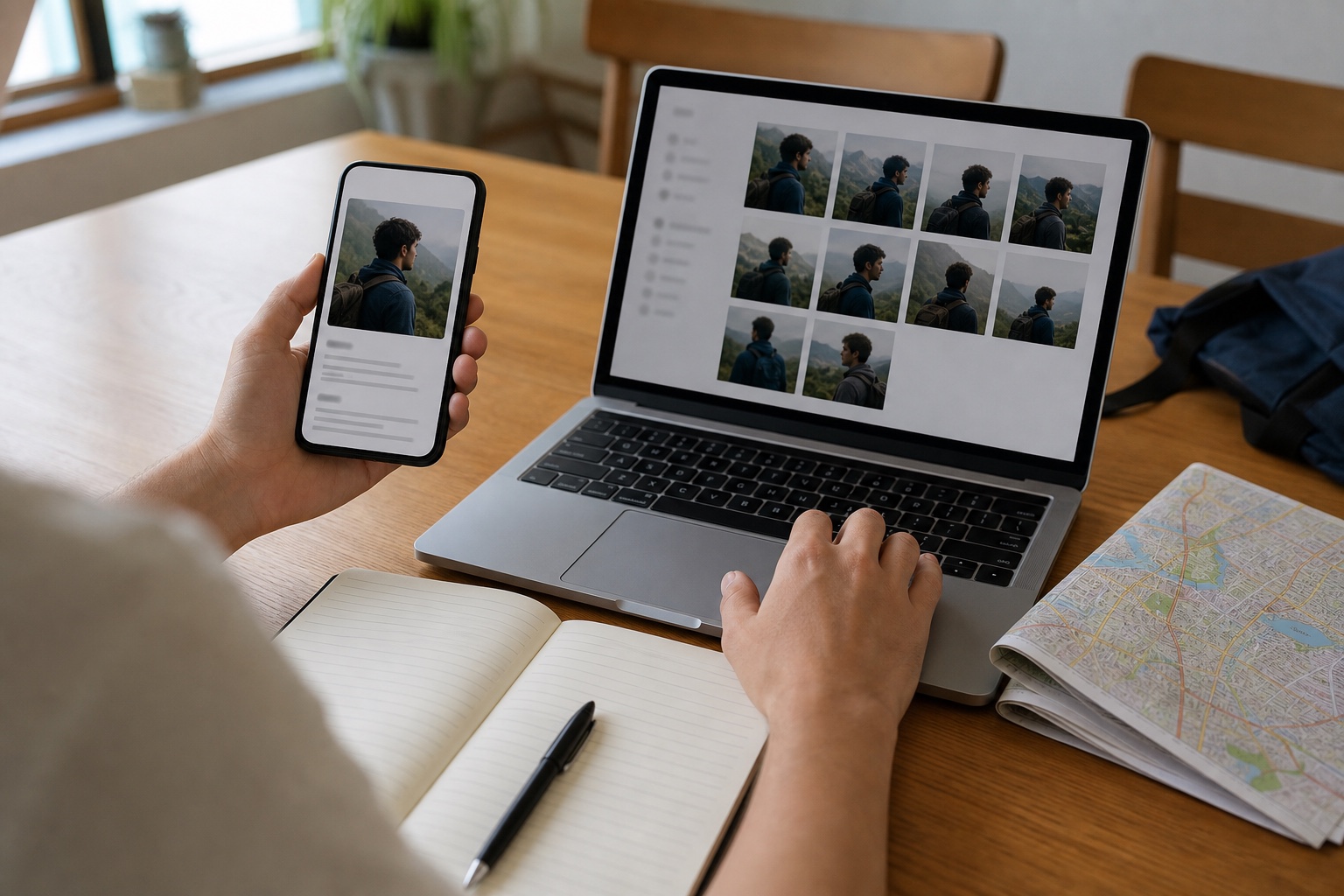
Interpret the result carefully. Finding the same portrait under different names, a copied professional biography, or a clearly unrelated person’s account is a strong contradiction. Finding no match proves very little. The image may be new, private, cropped, altered, synthetic, or simply absent from indexed pages. Do not convert “no result” into “identity verified.”
Search only information the match has voluntarily made public. Do not buy invasive data, contact employers, message relatives, publish accusations, or attempt to access private accounts. If a search reveals a contradiction, ask a neutral question only if doing so feels useful and safe: “This photo appears with another name. Can you explain?” You may also stop without confronting the person.
Look at the broader profile rather than obsessing over photographic flaws. Does the account have a plausible timeline? Do trip references match the conversation? Are captions generic across many places? Does every image hide the face while the person refuses a live call? None of those observations alone proves fraud. Together they may tell you that the uncertainty remains too high for a meeting.
Avoid using face recognition or attempting to identify bystanders in photos. The goal is to notice copied material and contradictions, not to identify a person beyond the context they offered. Protect your own image privacy too: RAINN advises avoiding dating photos reused on other public profiles and removing geolocation metadata that can reveal locations or timestamps.
Use a short video call as one signal
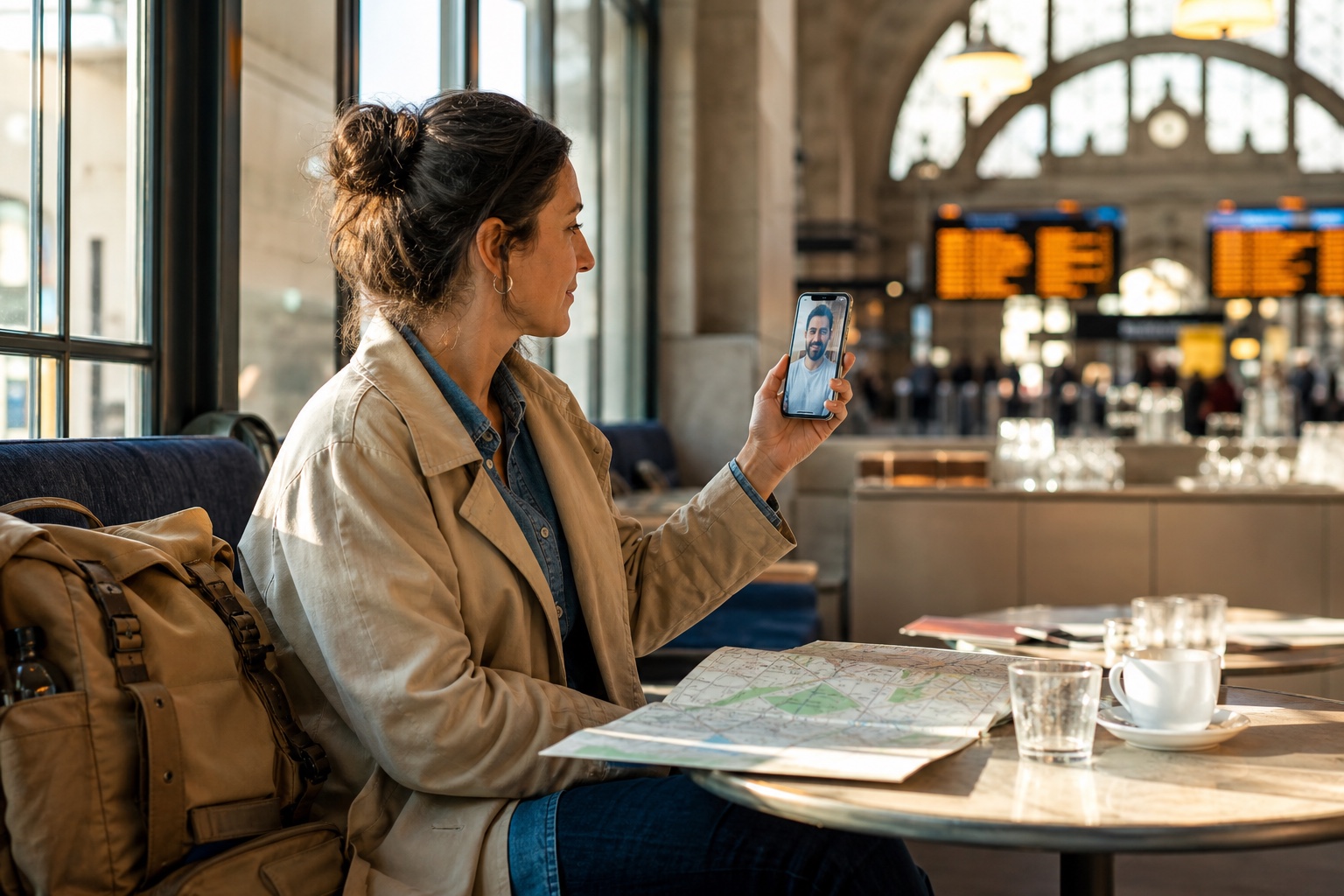
A five-minute video call can test whether the person looks broadly consistent with the profile, responds in real time, and can discuss the proposed city and meeting without obvious scripting. It also lets both travelers assess conversational fit before spending transit time and money. Keep the invitation low-pressure: offer a narrow window and accept that connectivity, accessibility, work, privacy, or time-zone constraints may require another format.

Do not make the call a performance test. Ask ordinary questions: “How did today’s train go?” “Which side of the station will you come from?” “Are you still comfortable with one drink and a hard stop at 20:30?” Look for an adult having a normal conversation, not a perfect backdrop or accent. Travel connections fail, cameras lag, and people can be shy.
A refusal is context, not automatic guilt. The useful signal is how the person handles your boundary. Someone may say, “My data is poor tonight; could we call from the hotel lobby Wi-Fi tomorrow?” That offers a proportionate alternative. Someone who becomes angry, pressures you to meet privately instead, sends a prerecorded clip while refusing any live interaction, or demands intimate images in exchange is giving you a different kind of answer.
Do not display your room, booking documents, workplace screen, passport, or other guests. Use a neutral public or common area, headphones, and a background that does not reveal where you sleep. Do not click a special “verification” link, install screen-sharing software, or read out a one-time code. A call should require only a familiar service you control.
The FBI’s romance-scam guidance notes that criminals can use fabricated profiles and persuasive communication, while newer FBI warnings describe AI-generated images and video as part of evolving fraud. That is why a video call is a consistency signal rather than a certificate. Pair it with behavioral boundaries and the real-world plan in Gallivanta’s guide to planning a first travel date as a solo traveler.
Test the travel story against real logistics
Travel stories have practical edges. Airports are not city centers. Check-in has a window. Luggage changes the route. Last trains and ferries create hard stops. A traveler working across time zones may have an evening call. You can test whether the proposed meetup respects those constraints without demanding proof documents.
Ask for a named public venue, not a pin inside a private building. Check the venue’s current official page or map listing yourself. Confirm the neighborhood, typical opening hours, staffed character, transit options, and whether you can leave without relying on the match. Gallivanta’s fair public meeting-point framework helps compare time, cost, transfers, visibility, and independent exits for both travelers.
Notice claims that require you to solve an emergency. A canceled flight does not make you responsible for buying a ticket. A lost wallet does not require your banking details. A visa delay does not justify sending fees. The U.S. Department of State’s scam guidance warns against sending money to someone abroad whom you have not met in person and describes romance scams involving hospital bills, visa fees, legal expenses, or urgent problems overseas.
Do not overvalue precise travel jargon. A scammer can copy airport codes, hotel descriptions, event names, or neighborhood details. Useful consistency comes from the complete pattern: ordinary answers, stable timing, willingness to meet publicly, no financial ask, respect for privacy, and no attempt to isolate you from friends or platform safeguards.
Illustrative scenario: Diego, 34, has an eight-hour daytime layover in Amsterdam and starts talking with a match who says she lives near the center. She first proposes a private apartment “to save time,” then says the train is down and asks Diego to pay for a car in advance. Diego checks the official transit status, sees normal service, and declines both the payment and private address. His concrete outcome is no meetup and no transfer; he stays with his original airport plan.
Protect money, documents, and private trip data
Keep a firm wall around money before meeting. Do not send cash, gift cards, cryptocurrency, tickets, deposits, “verification fees,” or funds for a supposed emergency. Do not receive money on somebody’s behalf, move funds between accounts, or carry luggage or packages across a border. FTC, FBI, and State Department guidance all identify money requests and fabricated emergencies as core romance-scam patterns.
Keep the same wall around documents. A stranger does not need your passport, visa, boarding pass, booking code, travel-insurance policy, work badge, bank statement, or proof of accommodation. Those records can expose full legal names, dates of birth, document numbers, addresses, loyalty accounts, and future movements. A blurred screenshot can still preserve metadata or reveal enough structure to be misused.
Protect your trip sequence. Share the public venue and the bounded time needed for coordination, not the hotel, room, entry code, daily routine, onward train, or complete itinerary. If you want a trusted friend to monitor the date, use the narrow plan in Gallivanta’s travel date location-sharing guide. The new match should not be the person receiving your safety share.
Account security belongs in the checklist. Use strong unique passwords and two-factor authentication on dating and email accounts. Do not approve login prompts you did not initiate. Do not scan a QR code or install an app sent by a match. Never share a one-time security code, even if the person claims it proves you are real. Platform verification should happen through the service’s own documented flow, not through a stranger’s link.
Set a practical first-date budget before social pressure starts. Pay your own fare and portion where possible, keep an independent exit fund, and reject any plan that makes return transport depend on the match. Gallivanta’s travel date budget plan explains how a small cost ceiling preserves choice when plans change.
Loving This Travel Dating Safety? Don't Explore It Alone.
Real Gallivanta members are planning trips to Travel Dating Safety right now. Join the community and turn your solo travel dreams into shared adventures.
Join Gallivanta FreeTurn verification into a public meeting plan
Verification earns consideration, not access. If the signals are consistent and you still want to meet, convert the conversation into a narrow plan: a staffed public venue, specific start, specific end, separate arrival, separate departure, small budget, and one backup in the same public zone. Keep the first meeting short enough that leaving on time feels normal.
Choose the venue based on current trip reality. If you have just landed, allow time for immigration, luggage, SIM activation, transit, food, and check-in. If you are leaving the next morning, protect sleep and the final train. If either traveler carries luggage, use a staffed station cafe or legitimate storage option rather than taking bags to a private home. Adventure can wait 45 minutes for the plan to become workable.
Save the venue and return route before leaving reliable Wi-Fi. The State Department’s current communication-abroad guidance recommends planning for connectivity, keeping devices charged, learning local emergency numbers, and maintaining backup communication information. Carry a compatible charger or power bank and a small offline route note. Do not let the match become your only map, translator, hotspot, or ride.
Tell a trusted person the public venue, match’s first name or profile, the platform where you met, start, hard end, and expected check-in. Agree what they should do if you are late. Keep the response proportionate: a call, a message, the venue desk, accommodation staff, or official local help depending on the facts. Do not invent an emergency number; verify it from an official destination source.
Have a backup that remains public and close. If the first cafe closes, move to the staffed hotel lobby or station concourse you selected in advance—not an apartment, car, beach, trail, or unfamiliar nightlife venue proposed in the moment. Gallivanta’s travel meetup backup plan shows how to keep the alternate inside the same transport and safety envelope.
Plan the ending before the beginning. You can say, “I have an hour before dinner with my hostel group,” or “I need the 20:42 train.” Leave while public transport is still frequent and your phone still has power. If the date goes well, another public plan is better than surrendering the safeguards that made the first meeting comfortable.
Strengthen the plan for women and higher-risk travelers
Women, LGBTQ+ travelers, disabled travelers, racialized travelers, people with visible religious identities, and anyone navigating unfamiliar language or laws may face added risks. Those risks vary by destination and person. Do not rely on a universal checklist; review current official destination guidance and adapt the meeting around your mobility, communication, legal, medical, and identity needs.
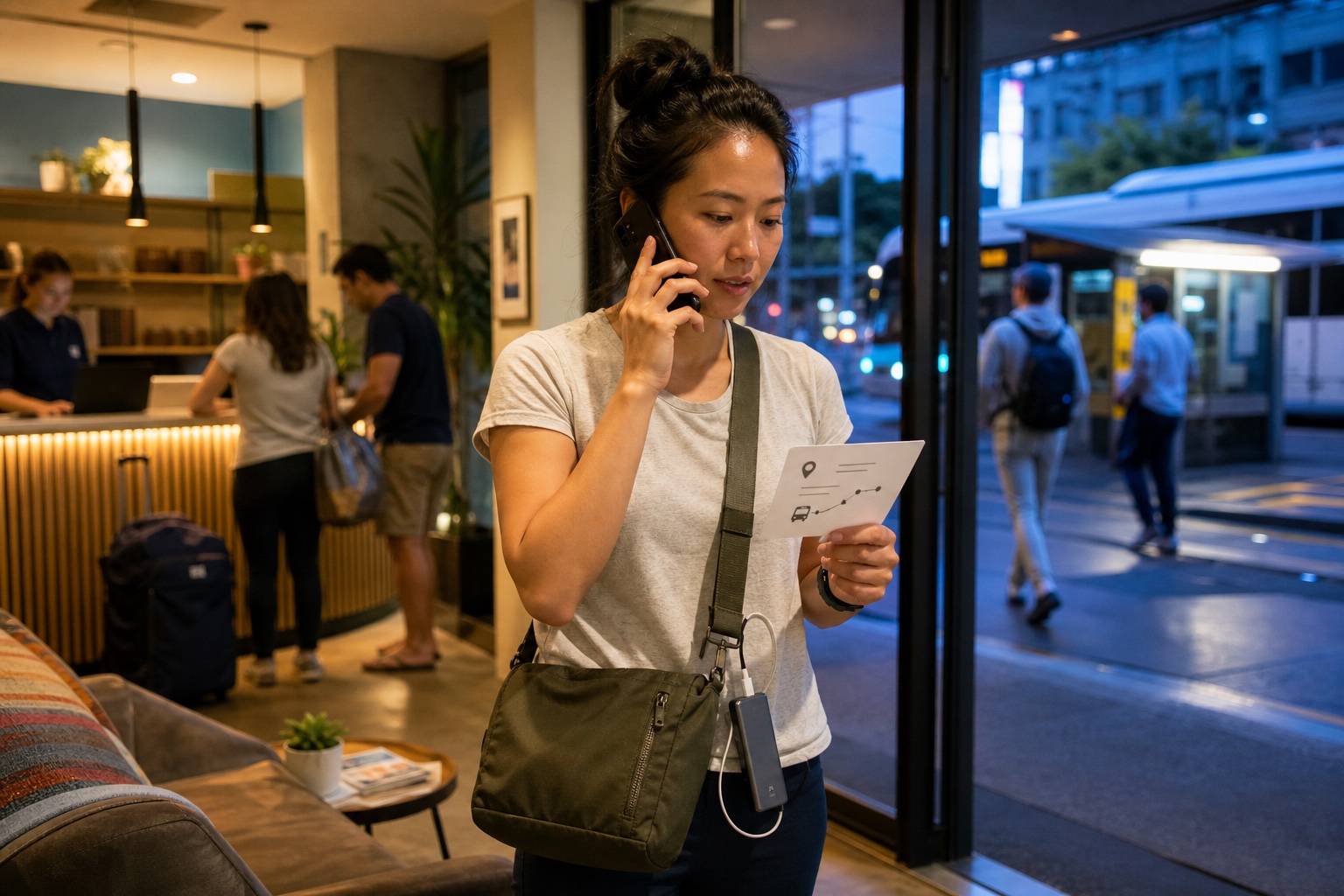
RAINN’s safer-dating guidance recommends waiting until you are ready, sharing plans with someone you trust, choosing a busy public place, controlling your own transport, planning an exit, watching for boundary-crossing behavior, and leaving when uncomfortable. The guidance also makes an important limit explicit: no precaution can guarantee safety or make a survivor responsible for another person’s harmful actions.
Make accessibility part of verification and logistics. Confirm step-free access from an official venue or transit source, not solely from the match. Keep medication, mobility aids, communication tools, and return transport under your control. If you use a personal assistant or interpreter, decide what meetup information they need and what remains private.
For queer travelers or anyone whose identity could create legal or social exposure, check current destination laws and official advisories before sharing profile details or agreeing to a venue. Avoid letting a match pressure you into a location where staff, transport, or communications are limited. Verification should never require outing yourself, revealing legal documents, or sharing intimate images.
Illustrative scenario: Aisha, 27, is in Bangkok for three days and agrees to meet a match after a 10-minute video call. She checks current official destination guidance, chooses a busy mall cafe at 17:30, confirms an accessible transit route, and sends her cousin the public venue and 19:00 check-in. When the match suggests switching to a distant private condo, Aisha keeps the original boundary and ends the plan when he persists. The concrete outcome is no meeting and an intact route back to her hotel area.
Build help routes before you need them. Save local emergency services, accommodation reception, transit support, and a trusted contact. If you experience sexual violence or coercion, seek local emergency or specialist support appropriate to your location. U.S.-based travelers can consult RAINN’s current support resources, but an overseas emergency still requires local services and destination-specific help.
Recognize stop signals and exit the conversation
Some signals call for an immediate stop rather than more verification: requests for money or financial access; pressure to carry an item across a border; threats; blackmail; demands for intimate images; links asking for account credentials; unexplained one-time-code requests; or a proposed first meeting in an isolated private place after you set a public boundary.
Other signals become meaningful as a pattern: rapid declarations of love, a profile that seems implausibly perfect, repeated emergencies, refusal of every proportionate live check, constant pressure to leave the original platform, isolation from friends, contradictory travel claims, or anger when you keep your own transport. The FBI specifically warns about rapid trust-building, isolation, reused photos, money requests, and promises to meet that never materialize.
You do not need courtroom proof to stop contact. “This does not work for me” is enough. Block and report through the platform when appropriate. Save relevant messages before blocking if there are threats, fraud, or abuse, but do not keep engaging to collect evidence at the expense of your safety.
If money has already moved, contact the financial institution or payment provider immediately and report the suspected fraud through appropriate official channels. The FTC directs people in the United States to ReportFraud.ftc.gov, and the FBI directs internet-fraud reports to IC3. Travelers elsewhere should use the relevant local services. This article does not promise recovery or provide legal advice.
If the person knows your hotel, route, or next stop, revise the plan. Tell accommodation staff, change the public meeting point, adjust the check-in, and avoid traveling alone to a place they selected. Use Gallivanta’s travel meetup exit strategy to leave a live interaction without debating your boundary.
Use scripts that keep verification proportionate
A script prevents social momentum from negotiating away the plan. Keep it short and factual. You are not asking permission; you are stating what works.
- For the short call: “Before I meet anyone while traveling, I do a five-minute video hello. I can call at 16:30 or 18:00.”
- For a public venue: “I only do first meetups in staffed public places. The station cafe at 18:00 works for one hour.”
- For document pressure: “I do not share bookings, ID, or accommodation details. The venue and time are all we need.”
- For money: “I do not send or receive money with someone I have not met. I hope you find another solution.”
- For a private switch: “I am keeping the public plan. If that no longer works, we will not meet.”
- For stopping: “I am no longer comfortable continuing this conversation. Do not contact me again.”
Watch the response. A respectful match may prefer another public time, explain a technical constraint, or accept that the meeting will not happen. Bargaining, ridicule, guilt, sexual pressure, or anger are not chemistry problems. They are decision data.
Use Gallivanta’s travel-first dating app approach to keep route, timing, and intent visible before a meeting. Travelers who want a broader framework can review solo travel dating built around traveler control or explore ways to meet travelers around shared routes and plans. A product can help organize context; it cannot replace judgment or safety planning.
Travel date verification checklist: action summary
- Read the profile again and note only the identity, intent, city, route, and timing details relevant to a meeting.
- Keep early conversation on the original platform when practical so its reporting and blocking tools remain available.
- Ask ordinary travel-logistics questions without demanding passports, bookings, employer details, or accommodation proof.
- Run a reverse-image search and treat a contradiction as significant while treating no result as inconclusive.
- Offer a short live call using a familiar service; do not click verification links, install software, or share codes.
- Confirm the public venue and its current hours through an independent official or reliable source.
- Reject money, gift-card, cryptocurrency, ticket, deposit, luggage, package, or account-access requests.
- Keep your hotel, room, entry code, passport, booking reference, future route, and full itinerary private.
- Choose a staffed public meeting point, hard end, small budget, same-zone backup, and independent transport.
- Save the route, charge the phone, carry a power backup, and verify the destination’s emergency contacts.
- Tell a trusted person the public plan, platform, expected end, check-in time, and proportionate response to silence.
- Strengthen the plan for your identity, destination, accessibility, communication, and legal context.
- Stop if the person pressures secrecy, private access, money, documents, isolation, or boundary exceptions.
- Remember that verification reduces uncertainty; it never guarantees identity, intent, compatibility, or safety.
The final decision test is simple: after the checks, can you meet without depending on this person for money, transport, connectivity, translation, accommodation, or permission to leave? If the answer is no, the plan is not ready. Keep talking from a distance or decline.
Sources, facts, and review boundaries
This guide was published and reviewed on August 28, 2026. Its factual claims about romance-scam patterns, reverse-image searching, dating-platform safeguards, public meetings, independent transport, travel communications, and reporting routes were checked against current public guidance from the U.S. Federal Trade Commission, Federal Bureau of Investigation, RAINN, U.S. Department of State, Google, and Australia’s eSafety Commissioner.
Platform features, verification processes, search results, AI capabilities, venue details, transit, connectivity, laws, advisories, emergency services, and reporting routes can change. Check current official information for the service, destination, and citizenship relevant to you. Gallivanta did not test identity-verification services, dating platforms, image-search accuracy, live-video authenticity, law enforcement response, or emergency services for this article.
The consistency model, question prompts, meeting sequence, scripts, and scenarios are advice and planning assumptions, not proof standards, professional investigations, legal advice, or guarantees. No statistic, testimonial, credential, traveler quotation, or customer story is claimed. Maya, Diego, and Aisha are invented composites, each labeled as an Illustrative scenario.
Primary and authoritative references used:
- U.S. Federal Trade Commission: What To Know About Romance Scams
- Federal Bureau of Investigation: Romance Scams
- RAINN: Tips for Safer Dating: Online and In-Person
- U.S. Department of State: Scams
- U.S. Department of State: Communicating While Abroad
- Google Search Help: Search with an image on Google
- Australian eSafety Commissioner: Online dating: How to stay safe
FAQ: Travel date verification checklist
Can a video call prove a travel match is safe?
No. A live call can test whether appearance, conversation, location context, and timing are reasonably consistent. It cannot prove intent, honesty, compatibility, or future behavior. Keep the first meeting public, bounded, and independently reachable even after a good call.
What should I check before meeting a travel match?
Check profile and story consistency, the photo’s public reuse, willingness to take a short live call, the reality of the proposed city and timing, respect for privacy, absence of money requests, and willingness to use a staffed public venue with separate transport.
What does a clean reverse-image search mean?
It means the search did not return an obvious public match. It does not verify the person. The image may be new, private, cropped, altered, synthetic, or unindexed. Use the result as one signal and continue with behavioral and logistics checks.
Should I send ID to prove I am real?
No stranger needs your passport, visa, boarding pass, booking confirmation, or banking information to arrange a public coffee. If a platform offers verification, use only its documented in-app process and understand what that process actually checks.
What if a match refuses a video call?
A refusal is not automatic proof of deception. Ask whether a proportionate alternative works, such as a call at another time. If the person pressures a private meeting, becomes hostile, or refuses every reasonable consistency check, you can decline without investigating further.
When should I stop verifying and block the person?
Stop when there are money or document requests, threats, blackmail, account-code requests, pressure for intimate images, private-location pressure, repeated contradictions, or hostility toward boundaries. Save relevant evidence when safe, then block and report through appropriate platform and official channels.

Fact-checked | Safety reviewed | Updated August 28, 2026
Ready to Meet Your Next Travel Date?
You've got the destination, the vibe, and the courage to go solo. Now all you need is someone who gets it. Join Gallivanta and meet fellow travelers who believe the best chapters start with a one-way ticket.
Join Gallivanta Free