
Your Next Adventure Could Change Everything
Join thousands of adventurous women who've discovered that the best travel stories often include a plot twist.
Start Your Adventure – Join Free
✓ Free to join ✓ No credit card required ✓ Join 50,000+ travelers
A travel date location sharing plan decides who can see your location, what they can see, when access begins, when it ends, and what happens if your phone, data, battery, or route fails. It is not permission for a new match to watch your entire trip. It is a narrow safety tool that helps a trusted person notice a missed check-in while your accommodation, daily routine, documents, and future route stay private.
Gallivanta’s travel-first position is straightforward: adventure first, sparks welcome, traveler control intact. A promising connection should fit the route, timing, intent, and privacy choices of both travelers. Location sharing can support that control when it is time-limited and directed to someone you already trust. It weakens control when a new person demands continuous access, treats a map dot as proof of interest, or uses the technology to replace a public meeting point and an independent exit plan.
Published and reviewed: August 26, 2026
- → Understand what the plan protects
- → Choose the trusted contact
- → Limit what and how long you share
- → Use phone tools without oversharing
- → Keep accommodation and future routes private
- → Build a battery, data, and offline fallback
- → Fit the plan around real travel logistics
- → Strengthen the plan for higher-risk travelers
- → Revoke access and respond to red flags
- → Use practical boundary scripts
- → Run the action checklist
- → Review sources and boundaries
- → Read the FAQ
What a travel date location sharing plan protects
A useful plan protects the traveler, not the date. It creates a small, deliberate signal for a trusted person while preserving everything the new match does not need: your hotel or hostel, room number, entry code, complete itinerary, passport details, work schedule, next destination, and habitual route. The plan should make it easier to get help after a missed check-in without making it easier for somebody new to follow you.
Start by separating three kinds of information. The new match needs the agreed public meeting point, start time, and enough route context to arrive independently. A trusted contact may need that public location, the expected end, your independent return plan, and a specific action if you miss a check-in. Only you need the exact accommodation, booking details, document images, and complete trip sequence unless a genuine emergency requires otherwise.
This is why a location-sharing tool cannot repair a weak date plan. A live dot does not make a private apartment public, restore a canceled train, charge a dead battery, identify a safe exit, or tell a friend what response you want. First use Gallivanta’s framework for choosing a fair, public travel date meeting point. Then add location sharing only where it solves a defined problem.
Your plan also needs a stop condition. “Until I remember to turn it off” is not a boundary. Choose a short window tied to a real event: departure for the venue, arrival at the public meeting point, the planned end, or return to a public transit hub. Review access immediately afterward. A good plan expires by design and does not become permanent surveillance through inertia.
The focus is not maximum visibility. It is minimum necessary visibility plus a clear response. A trusted person who knows you are due to check in at 21:15 and should call once before contacting local help has more useful context than somebody staring at your movement all evening without knowing the plan.
Choose the trusted contact before the match
Choose the recipient before social momentum begins. The right person is someone you already know, who respects your privacy, is likely to be awake in the relevant time zone, and can follow a simple plan without escalating ordinary delays into panic. They do not need to be physically nearby, but they should know how to reach you and what “missed” actually means.
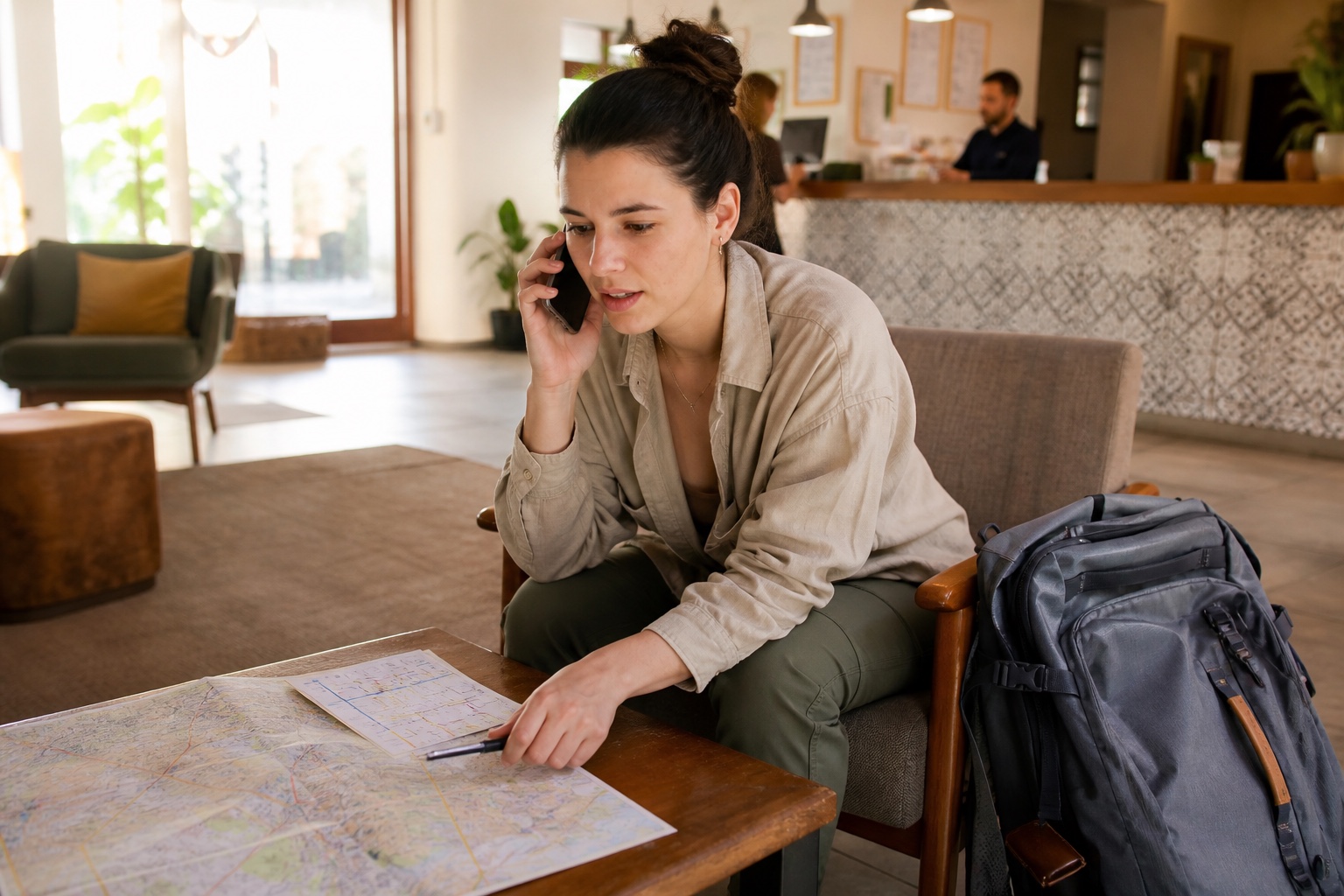
Give the trusted contact a compact brief: the public venue, the time zone, planned start, hard end, transport method, expected next check-in, and one or two escalation steps. For example: “If I have not checked in by 21:15 local time, call once. If I do not answer within 15 minutes, contact the hostel desk and then the local emergency route we saved.” Adapt the response to the destination and your circumstances; do not invent an emergency number.
Do not make the new match the safety contact. Sharing your live location with the person you are evaluating defeats the separation the plan is meant to create. They already know where the meetup is. They do not need a map of your approach, your accommodation, or your route after you leave. If coordination is difficult, share a public landmark or a temporary arrival message rather than continuous movement.
Ask the trusted person not to forward screenshots, add another viewer, post the location, or message the match. Explain when the information should be deleted. The contact is supporting your decision-making, not supervising your social life. Gallivanta’s broader guide to planning a first travel date helps keep the check-in proportional to the actual meetup.
Illustrative scenario: Leila, 29, is in Lisbon for four nights and plans a 75-minute cafe date at 18:00 before a 20:30 dinner with hostel friends. She sends her sister the cafe name, the metro station she will use afterward, and a 19:45 check-in time. Her sister is told to call once, then contact the staffed hostel desk if Leila is silent for 20 minutes. Leila checks in from the station at 19:30. The concrete outcome is a useful safety layer without sending her match the hostel address or the rest of her evening.
Decide what to share and for how long
Build the share from purpose, scope, duration, and recipient. Purpose answers why the share exists. Scope defines the data. Duration states when it ends. Recipient names exactly who receives it. If any of those four elements is vague, simplify before turning the feature on.
For many first meetups, a timed text check-in is enough. A trusted person gets the public venue and the expected end; you send “arrived,” “leaving,” and “back at my public checkpoint.” Real-time sharing may be useful when the route is unfamiliar, the traveler faces higher risk, or a destination-to-destination check-in can detect that you did not arrive. It should still be time-limited and directed only to the trusted contact.
Avoid sharing a full-day route. A travel date is one bounded event inside a trip. Start the window after you have left the accommodation area if revealing that area creates unnecessary exposure. End it at a public hub rather than directly at your lodging when practical. If you need support for the final walk, share that segment with the trusted contact, not the date.
Think about what the recipient can infer. A location history can reveal where you sleep, when you are alone, where you work, which religious or health services you visit, and where you plan to go next. Battery status, travel mode, arrival alerts, and last-active data can add context. Useful tools often share more than a single dot, so read the feature description and choose the narrowest setting that meets the purpose.
Consent also applies between friends. Ask whether the person is willing to receive the check-in, tell them the window, and make clear that you remain responsible for your route decisions. Do not silently turn a friend into an emergency monitor. If they cannot participate, pick another contact or use a simpler self-managed plan.
Use phone tools without oversharing
Use a tool you already understand, set it up before leaving reliable Wi-Fi, and test it with the trusted contact. Do not install a new app from a link sent by a match. Do not hand over an unlocked phone so another person can configure sharing. Keep the account, passcode, recovery methods, and permission choices under your control.
Apple’s current Personal Safety guide to Safety Check says the feature on iPhone with iOS 16 or later can review who has access to information, stop sharing, review devices connected to the Apple Account, reset app privacy permissions, and change certain account protections. Apple also warns users to consider safety impacts before removing access because changes can affect a risky situation. Treat Safety Check as a review and response tool, not a guarantee that every non-Apple service has been covered.
Apple’s Check In guide for Messages explains that iOS 17 or later can notify a trusted contact after arrival or after a timer, with selected information sent if the check-in does not complete. Apple notes that availability can vary by region and that both sender and recipient need compatible software. Check the current requirements on your own devices rather than assuming the feature will work abroad.
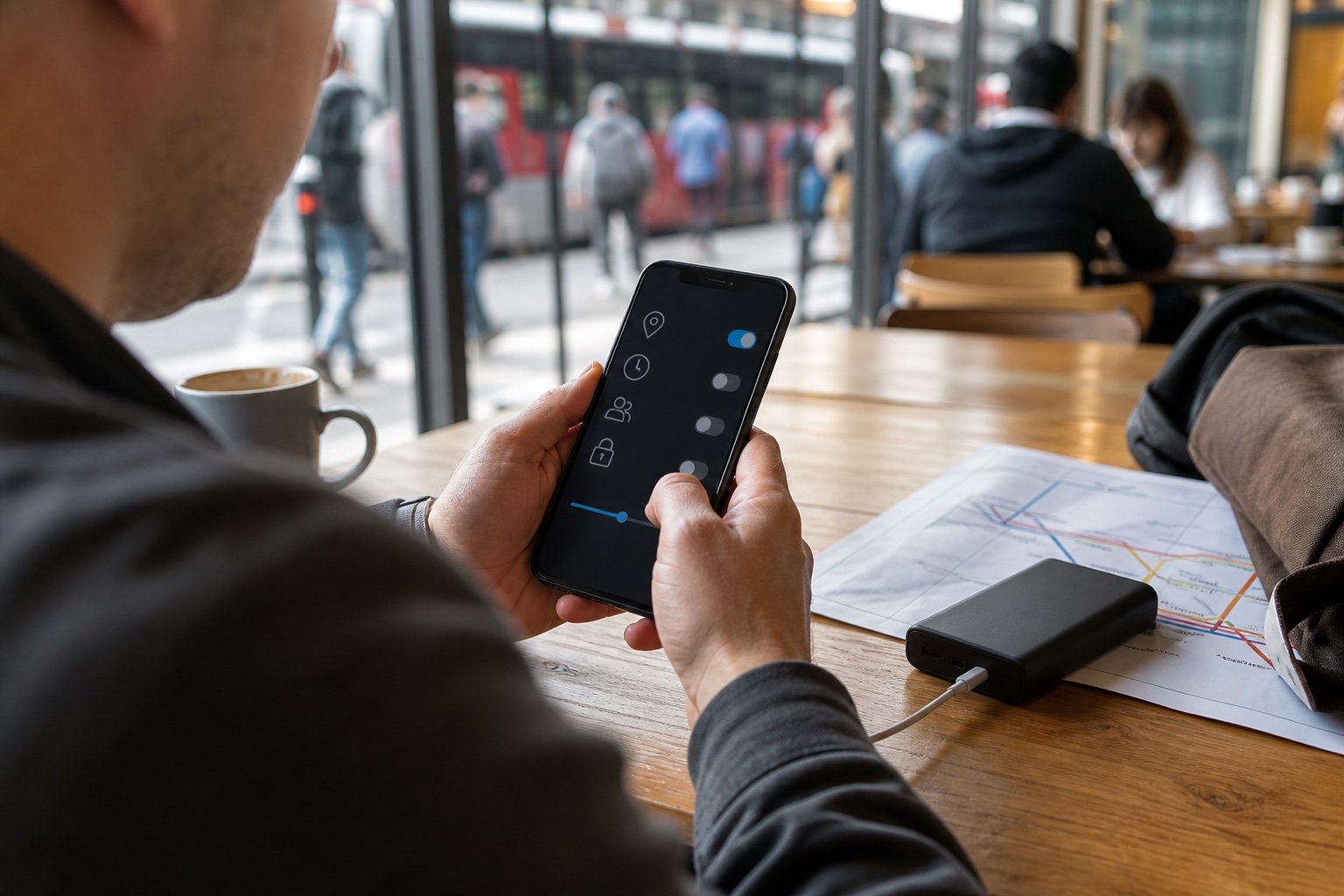
Google’s official Maps location-sharing guidance says users can choose who sees their location and for how long, and that a recipient may also see information such as the account name and photo, recent device location, battery status, and possibly arrival or departure information. Google’s Android location-sharing settings guide also notes that settings can be device- and account-specific. Review every signed-in device and stop the share when the purpose ends.
These features have different behavior, requirements, and regional limits. This article does not rank them or claim that one is universally safer. The best option is the smallest reliable tool available to you and your trusted contact, backed by a non-app plan. Gallivanta’s solo travel dating safety plan before landing can help you do this work before jet lag and arrival pressure compress the decision.
Keep accommodation and future routes private
Your accommodation is not the meeting point, backup venue, luggage solution, restroom stop, charging station, or default end of the date. Meet at a named public place that both travelers can find independently. If you are coming from a hotel or hostel, describe the station, square, or neighborhood entrance you will use, not the building where you sleep.
Map previews and shared routes can expose more than the destination. Before sending a screenshot, check whether it shows your blue dot at the hotel, a saved “Home” label, recent searches, calendar details, contact names, or future bookings. Crop to the public landmark when a static image is genuinely useful. Better still, send the official venue link and confirm a specific entrance.
Do not share room numbers, booking codes, door PINs, Wi-Fi passwords, luggage tags, passport images, or a full itinerary. A person does not need those details to meet for coffee. If they ask where you are staying, a broad area is enough: “I am staying near the central station, but I meet people at public venues.” A respectful match can coordinate from that information.
The same rule applies after the date. Do not leave continuous sharing active because the meetup went well. Chemistry is not identity verification, and one pleasant hour does not establish a need for ongoing access. If you both want a second meeting, build a second bounded plan. Gallivanta’s guide to meeting travelers around the trip you are already taking supports route and timing context without turning complete itinerary access into a test of trust.
If the other person offers a ride, you can decline without revealing the accommodation. Order your own verified transport to a public checkpoint or use the route you planned. The travel meetup exit strategy explains why a clean end is part of the date, not evidence that the connection failed.
Build a battery, data, and offline fallback
Location sharing depends on power, connectivity, account access, permissions, and device behavior. Any one of them can fail. A missing dot may mean a tunnel, weak signal, dead battery, disabled permission, delayed background update, or a real problem. Your contact needs a response plan that does not treat the map as perfect evidence.
Before leaving, charge the phone, carry a compatible power bank and cable, and keep enough battery for maps, tickets, authentication, accommodation access, and the return route. Location sharing is not allowed to consume the power reserved for leaving. If the phone is already low, shorten the meetup, use a static check-in plan, or reschedule.
The U.S. Department of State’s current guidance on communicating while abroad advises travelers to check international service, consider roaming or local SIM options, save emergency and consular contacts, plan backup communication, keep devices secure, update software, use trusted apps, and learn the local emergency number. The advice is written for U.S. travelers; people of other nationalities should use the equivalent official guidance for their destination and citizenship.
Download only what actually works offline. Google’s offline Maps guidance says a saved area can support navigation when connectivity is weak, but offline walking, cycling, and public-transit directions are unavailable, and availability varies by country or region. Save a simple route card with the venue address, public backup point, transit line, lodging front desk, and trusted contact number. A paper copy can be more useful than a perfect app on a dead phone.
Loving This Travel Dating Safety? Don't Explore It Alone.
Real Gallivanta members are planning trips to Travel Dating Safety right now. Join the community and turn your solo travel dreams into shared adventures.
Join Gallivanta FreeAgree on a no-data message before the date. It can be as simple as a normal SMS code or a scheduled call from a staffed venue. Do not depend on a single messaging platform, especially if a local SIM changes your number or public Wi-Fi requires a browser login. Gallivanta’s travel meetup backup plan offers a same-zone fallback for weak data, delays, and closed venues.
Fit sharing around arrival, check-in, and transit
Arrival estimates are not meeting times. Immigration, baggage, station transfers, local cash, SIM activation, food, medication, and lodging check-in can all change the usable window. Finish those tasks first or leave a realistic buffer. A travel date location sharing plan should begin when the traveler is ready, not when the flight tracker says the plane touched down.
Work backward from the next fixed point. Name the local time zone, public meeting point, start, hard end, last comfortable transport, accommodation check-in cutoff, and trusted-contact check-in. Include walking time, ticket purchase, station access, luggage, accessibility, and a disruption buffer. The share window should follow that plan rather than expanding to cover improvisation.
Gallivanta’s public-first planning guide before check-in explains why a neutral venue and verified lodging access should come before a social detour. Do not reveal the accommodation because you are late. Move the date to the public fallback, shorten it, or cancel.
Illustrative scenario: Mateo, 33, arrives in Mexico City at 14:20 for a remote-work week and has a 17:00 apartment check-in appointment. He declines a 15:30 date because the timing would force him to share the rental address and carry luggage into the meetup. After checking in and testing his data, he schedules a 19:00 food-hall meeting. He gives a trusted colleague the public venue and a 20:30 check-in, then ends sharing at a staffed metro entrance. The concrete outcome is a relaxed connection that does not expose the rental or jeopardize access.
For long layovers, do not let location sharing create false confidence about terminal access. Security, immigration, gates, baggage, and transit between terminals still decide whether a meetup is feasible. For road trips, preserve fuel, daylight, independent keys, and the planned overnight stop. For digital nomads, protect the next work block and authentication access. For backpackers, include reception hours, lockers, and the route with luggage.
Strengthen the plan for women and higher-risk travelers
Women, LGBTQ travelers, disabled travelers, travelers facing racism or xenophobia, and people whose visibility, mobility, documentation, or local legal context increases risk may need a narrower share, an earlier venue, a closer trusted contact, or a more direct escalation route. The plan should reflect the traveler’s actual risks without pretending one checklist can make every destination safe.

Prefer staffed public places, earlier hours, accessible exits, multiple transport options, visible prices, and a short first meeting. Verify the route yourself. Keep your phone and mobility aids in your control. Do not accept a private pickup, companion app, tracking tag, shared account, or “safety” installation from a new person. A request framed as protection can still create access you did not choose.
Technology abuse requires care. The U.S. Federal Trade Commission’s current consumer guidance on stalkerware explains that covert software may track location and other device activity. The FTC warns that removing suspected monitoring can alert an abusive person and potentially escalate danger; it recommends considering safety first and seeking help from a different device when monitoring is suspected. This is not a do-it-yourself diagnosis. Use a qualified local advocate or official support route appropriate to your situation.
If changing a permission, password, or shared account could affect an abusive partner or controlling companion, do not assume the standard “turn it off now” advice is safe. Plan the change. Preserve evidence when appropriate, use a safer device, and contact a specialist service. Apple similarly warns users to consider safety impacts before making access changes in Safety Check. The right response depends on the situation.
Accessibility belongs in the location plan. A map dot does not show a broken lift, inaccessible platform, sensory overload, medication need, or personal-assistance delay. Tell the trusted contact what counts as a meaningful missed check-in for you, and select routes that preserve accessible alternatives. Gallivanta’s guide to dating safely as a solo female traveler expands the public-place, transport, and boundary framework for women.
Illustrative scenario: Noor, 36, a queer traveler using a cane, meets someone at a staffed museum cafe in Berlin at 16:30. She shares a timer-based check-in with a longtime friend, not the match, and names the step-free station she plans to reach by 18:15. When the nearest lift is closed, Noor sends the agreed delay message, uses her saved accessible backup route, and ends the share at a staffed interchange. The concrete outcome is a calm adjustment without revealing her hotel or accepting an unverified ride.
Revoke access and respond to red flags
End the share when the defined purpose ends, then verify that it ended. Review the person list, link status, device list, app permissions, and any arrival or departure notifications. If the tool is account- and device-specific, check each relevant device. Delete unnecessary screenshots or route notes from shared chats and ask the trusted contact to do the same.
Pressure is a signal. Leave or cancel if a match demands live location, asks for the hotel, objects to a trusted contact, wants proof that you are alone, sends an app-install link, asks to hold your phone, requests an account password or one-time code, adds a tracking notification, or becomes angry when access expires. You do not need to prove malicious intent before protecting the trip.
Do not negotiate technology permissions in an isolated place. Move toward staff, transport, security, or another public group. Use your independent route. If the person follows, blocks you, takes the phone, or threatens you, contact the appropriate local emergency service. A delayed date can be repaired; lost control of the route is a different problem.
If you suspect unauthorized access after the meetup, use a safe device to review official platform guidance and account sessions. Change protections only after considering whether the action could alert somebody dangerous. The FTC and Apple sources above both emphasize safety planning around monitoring and access changes. No article can assess your specific risk from a distance.
Gallivanta’s solo travel dating product guide centers the trip rather than random proximity. A compatible connection respects the venue, the time limit, and the privacy boundary. Continued access is never the price of keeping the spark alive.
Scripts that keep the boundary clear
Short language makes the plan ordinary and difficult to misread:
- Naming the public point: “I meet new people at public venues. Let’s use the staffed cafe inside the north entrance.”
- Keeping the hotel private: “I am staying in this area, but I do not share my accommodation address.”
- Choosing the recipient: “I use a trusted friend for check-ins. I do not share live location with new matches.”
- Limiting the window: “My check-in runs only for the route and ends at the public transit hub.”
- Handling weak data: “If messages fail, wait at the agreed entrance for ten minutes. After that, we both continue our plans.”
- Declining an installation: “I do not install apps or profiles from people I have just met.”
- Ending pressure: “This boundary is not open for debate. I am leaving by my planned route.”
- Planning a second date: “Tonight’s access ends tonight. We can choose another public plan for next time.”
These scripts are advice, not universal cultural rules. Adapt the tone and language while keeping the boundary. If direct refusal could increase immediate risk, prioritize moving toward help over explaining. The goal is not to win an argument about privacy; it is to retain the route, device, and decision.
Gallivanta’s travel dating app overview emphasizes route, timing, and intent context. Use that context to coordinate the public meetup. It should reduce the pressure to expose a full live location or complete itinerary.
Travel date location sharing plan checklist
Run this checklist before either traveler leaves reliable Wi-Fi:
- Choose one trusted contact who is available in the correct time zone.
- Share the public venue, start, hard end, return checkpoint, and escalation plan.
- Keep the new match, accommodation, room number, codes, documents, and full itinerary outside the share.
- Decide whether a timed message, timer, destination check-in, or short live share is actually necessary.
- Set the exact recipient, start, duration, information level, and stop point.
- Test the feature with the trusted contact before the meetup.
- Review what extra data the tool exposes, including battery, route, account photo, or arrival alerts.
- Charge the phone and carry a compatible cable and power bank.
- Protect battery and data for tickets, maps, authentication, check-in, and the independent exit.
- Save the venue, public fallback, transit route, lodging desk, and official emergency route offline.
- Learn the destination’s real emergency number from an official source.
- Keep your device, accounts, passcodes, mobility aids, and transport under your control.
- Leave if a person pressures access, private locations, installs, passwords, codes, or continuous tracking.
- End the share at the planned point and verify access, devices, and notifications afterward.
- Use a safer device and specialist support if you suspect covert monitoring or technology abuse.
The final test is simple: can a trusted person respond to a missed check-in while the new match still cannot see where you sleep, how you move through the rest of the trip, or where you go next? If not, narrow the plan. Location sharing should protect traveler control, not trade it away.
Sources, facts, and review boundaries
This guide was published and reviewed on August 26, 2026. Its factual claims about phone features, location-sharing behavior, offline navigation, travel communication, and stalkerware were checked against current public guidance from Apple, Google, the U.S. Department of State, and the U.S. Federal Trade Commission. Device software, regional availability, account behavior, privacy settings, laws, emergency services, mobile coverage, and official guidance can change. Verify the current instructions for your device, destination, and citizenship before acting.
The recipient model, time limits, route card, scripts, check-in timing, and scenarios are advice and planning assumptions, not universal legal or safety rules. Gallivanta did not test Apple or Google features, mobile networks, emergency services, advocacy resources, or device forensics for this article. No statistic, testimonial, credential, traveler quotation, or customer story is claimed. Leila, Mateo, and Noor are invented composites, each labeled as an Illustrative scenario.
Primary and authoritative references used:
- Apple Personal Safety User Guide: Safety Check for an iPhone with iOS 16 or later
- Apple Personal Safety User Guide: Use Check In for Messages on iPhone
- Google Maps Help: Share your real-time location with others in Google Maps
- Android Help: Manage your Location Sharing settings
- Google Maps Help: Download areas and navigate offline
- U.S. Department of State: Communicating While Abroad
- U.S. Federal Trade Commission: Stalkerware: What To Know
FAQ: Travel date location sharing plan
Should I share my live location with a travel date?
Usually, share with a trusted person you already know, not the new match. The match needs the public meeting point and time. If live sharing is useful for the route, limit the recipient, duration, and data, then verify that access ends at the planned checkpoint.
What should a travel date location sharing plan include?
It should name the trusted contact, public venue, start and hard end, independent route, expected check-in, exact response to silence, sharing method, data scope, duration, and stop point. It should also include a battery, connectivity, and offline fallback.
Is a timed check-in better than continuous location sharing?
It can be. A timed message or destination check-in may provide enough safety information with less exposure. Continuous sharing is not automatically safer, and it can reveal accommodation, routines, route history, battery information, or future movement. Choose the smallest reliable tool for the actual purpose.
Can location sharing work without mobile data?
Do not assume it will. Behavior depends on the device, app, permissions, region, and connectivity. Download useful route information, save contact numbers, carry power, and agree on a basic SMS, call, or staffed-venue fallback before the meetup.
How do I stop sharing after the date?
Use the platform’s current official instructions, then verify the recipient list, link status, account devices, app permissions, and any arrival or departure notifications. If you suspect abuse or covert monitoring, consider safety impacts before making changes and seek qualified help from a safer device.
What are red flags around location sharing on a travel date?
Red flags include demands for continuous access, hotel details, proof that you are alone, app or profile installation, an unlocked phone, passwords, one-time codes, tracking notifications, shared accounts, or anger when access expires. You can end the meetup without proving why the person wants the data.

Fact-checked | Safety reviewed | Updated August 26, 2026
Ready to Meet Your Next Travel Date?
You've got the destination, the vibe, and the courage to go solo. Now all you need is someone who gets it. Join Gallivanta and meet fellow travelers who believe the best chapters start with a one-way ticket.
Join Gallivanta Free