
Your Next Adventure Could Change Everything
Join thousands of adventurous women who've discovered that the best travel stories often include a plot twist.
Start Your Adventure – Join Free
✓ Free to join ✓ No credit card required ✓ Join 50,000+ travelers
A travel date language and translation plan is the rule that you can order, read a bill, leave, and ask staff or emergency services for help in words you prepared, while your phone stays in your hand. A shared language is pleasant. It is not a requirement for a first public hour, and it is not a reason to make a new match your interpreter.
Gallivanta’s travel-first position is adventure first, sparks welcome, traveler control intact. Language is one of the controls. You can be warm with a small vocabulary. You can also be specific about the cafe, the time, and the fact that you will arrive and leave on your own. A good conversation can use short sentences, a menu you can point at, and a second public place. It does not need someone else to speak for you.
Published and reviewed: October 16, 2026
This plan sits beside your emergency and consular plan, your phone and data plan, your message channel plan, your budget plan, and your pre-landing safety plan. Save one plain sentence for the operator, and do not make the match your only translator for that call. The solo packing list treats an offline language download as gear. This page is where those lines become a meetup plan.
Keep four truths separate. Facts are how emergency numbers, official scam warnings, and on-phone translation actually work, with the official pages cited below. Examples are illustrative composites for teaching, not testimonials and not reports about real guests. Assumptions are personal risk tolerances that differ by traveler, city, and the languages you already speak. Advice here is operational hygiene for a short public meetup. It is not a guarantee of safety, not legal advice, and not a substitute for local emergency services or for your own government’s travel advice.
- → Why the language plan matters
- → Decide what you can say yourself
- → Prepare the phrases before you fly
- → Use your own phone
- → Read the menu and the bill yourself
- → Speak to staff and save one emergency sentence
- → Strengthen the plan when risk is higher
- → Recognize language red flags
- → Use calm language scripts
- → Run the action checklist
- → Review sources and boundaries
- → Read the FAQ

Why a language plan matters on a travel date
Travel dating already compresses the usual checks. A language gap compresses them again. You may have matched in English, landed in a city where the menu, the metro signs, and the emergency operator use another language, and agreed to coffee before you know whether you can ask for the bill. In that window, “I’ll order for you” can sound like manners. It can also be the moment someone else starts deciding the drink, the venue, and the story staff hear.
Other Gallivanta guides mention language in a sentence. The emergency plan says to save one sentence and not to make the match your only translator. The transportation plan lists a language barrier as a reason to tighten the route. The guide to dating safely as a solo female traveler notes that a language barrier can hide a warning. None of them is the language plan itself. This page answers the practical question: how do you stay understood without handing the hour to someone else’s words?
Privacy and clarity are the same habit here. You can be curious about a city and still order your own coffee. A respectful match can meet you at a staffed public place, point at a menu, and accept a short sentence. Pressure to become your translator before a public pin exists is information about control, not about chemistry.
Keep four layers separate. Your words are the few lines you can say or show without help. The device is the phone that may hold a translation. The bill and the order are what you actually agreed to pay for and consume. Help is the sentence you can give staff or an emergency operator if the hour goes wrong. A match can sit inside the conversation. They do not get to be the only voice in all four layers.
Decide what you can say yourself before you say yes
Before you confirm a meetup, write a private line for yourself: the language of the city, the phrases you will have ready, and the public pin you will actually use. Then mark the jobs you will not delegate.
| Enough to coordinate | Stays off their side of the table |
|---|---|
| A staffed public pin, a start time, and an end time | A match who orders, pays, and explains you to staff |
| A few phrases you prepared, plus pointing at a menu | Your unlocked phone, used as their translator |
| The fact that you will arrive and leave on your own | Your hotel name, flight, or door code inside a translation |
| One plain sentence for the local emergency number | A private room “so we can understand each other” |
What you can say is smaller than what a restless chat asks for. “Let’s do the station cafe at 4. I’ll order my own coffee, and I’ll get there on my own.” That is a complete plan. Your meeting-point guide still chooses the pin. This plan chooses who speaks for you once you are there.
If an earlier message already said “please order for me,” freeze that offer. Tell them you will choose from the menu yourself. Use the public-first arrival habit so the place has staff you can see. A language gap is a reason to pick a simpler venue, not a reason to skip the public door.
Illustrative scenario A, the order that was framed as help: A traveler in Prague is told the menu is impossible and that an “English student” should order for both of them, in a quieter room upstairs. No drink has been chosen yet. With a language plan, the reply keeps the meetup at a staffed counter and the traveler points to one item. If you are choosing that counter, the Prague date-spot guide is a list of public ideas, not a reason to hand over the order. The upstairs room was the ask. The coffee was optional.
Prepare a few phrases before you fly
You do not need fluency. You need a short list you can show or say when you are tired. Translate it before you fly, while you still have time to notice a bad result. Do the work at home, not at the table.
- Coffee or tea, please.
- I will pay for my own.
- The bill, please.
- I am leaving now.
- Where is the metro?
- Please call a taxi.
- I need help.
- I need the police.
- I need an ambulance.
- I do not want that.
- Please talk to me.
Translate those lines into the language of the city. Then check them a second time, with a person who speaks that language or with a second tool, before you travel. A second look can catch an obvious mistake. It does not make the line perfect. If you cannot check them, keep the English and the emergency number anyway. A short sentence you understand is more useful than a flourish you cannot read back.
Save the lines in a note that does not include your hotel, your flight, your next city, or a door code. Those facts belong to your accommodation privacy plan and your itinerary privacy plan. A translation note is a bad place to store them, because the screen is easy to tilt toward the table.
If you use an iPhone, Apple’s guide to the Translate app says you can download languages and translate on the phone without an internet connection, for supported languages. The same guide says to check which languages are available. Download the one you need before you fly, and confirm it opens while the phone is offline. If you use another phone, confirm that phone’s offline option in the maker’s own help. Do not install a translator from a link in the dating chat. The message channel plan covers surprise links and files.
On landing, run a two-minute test before you agree to a time. Open the saved phrases. Open the offline translation if you downloaded one. Open the map for the neighborhood, which is the phone plan’s job, and pair it with your daylight window. If the phrases are missing and the data does not work, the meetup waits. A first coffee is a bad moment to discover that the only words in the room belong to someone else.
Travelers who use Gallivanta to find travel-first connections can keep that first coordination in the product. A public pin and a time window do not require a shared local language, and neither does the match.
Keep the translation on a phone you are holding
A translation app is a reference. It is not a person you deputize, and it is not a reason to pass the device across the table. Type the word yourself. If you want them to help, they can say the word out loud while you type it. The screen faces you.
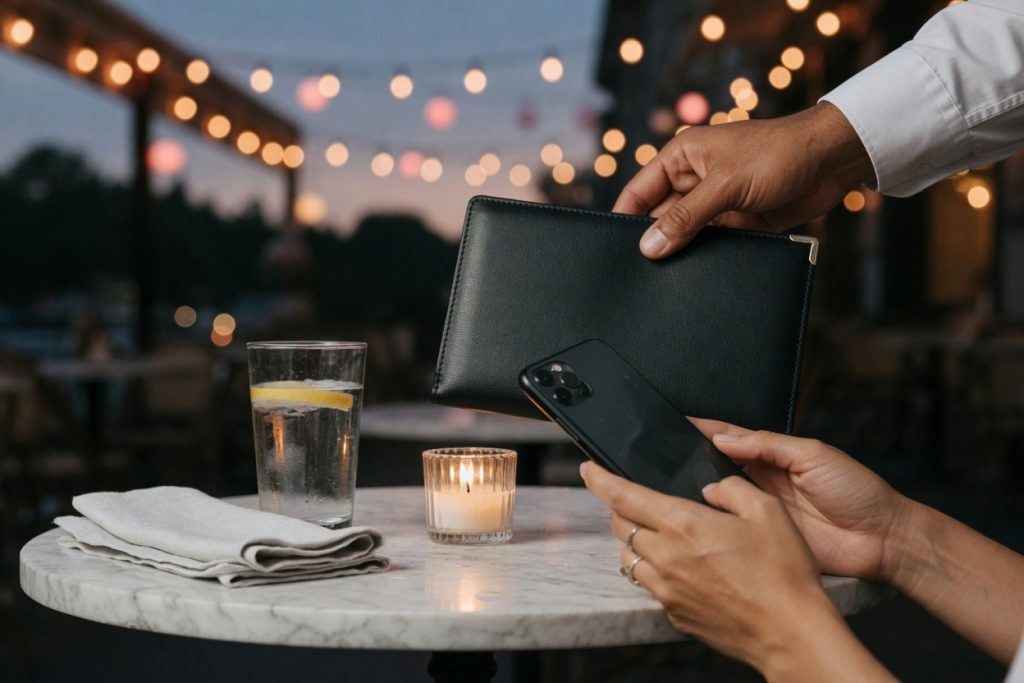
Decline a request to hold the phone, unlock it, or “just put the translation in.” An unlocked phone is access to messages, photos, and login codes. That boundary is the phone and data plan. The language plan adds one rule: the translation is not an exception. A helpful sentence does not need your banking apps.
Decline a QR code or a link sent “so the menu translates” or “so you can hear the right accent.” A code you did not choose is a link you did not choose. Use the app you installed before the trip, on data you tested before you left your room. You can also point at a printed menu with no connection at all.
Do not dictate your lodging, your passport number, a booking code, or a door code into a translator while anyone else can see or hear it. Offline translation, where your phone offers it, is for the menu and the exit. It is not a form for private trip data. Your personal info boundary still decides which facts stay offline. Translation does not move that line.
Speak your own check-in. Your trusted contact should receive the pin, the start, and the end in a language you and the contact already share. Do not ask the match to translate that message, and do not add the match to the thread. The check-in protocol is the packet. This plan only keeps the match out of the role of narrator.
Illustrative scenario B, the phone that was borrowed for a word: A traveler in Barcelona is offered a translation link, then a hand reached out for the unlocked phone, “so the second spot is right.” The language plan uses phrases already saved, or a word typed by the traveler. A second place, if there is one, comes from the backup plan: another public pin in the same zone, named out loud. The Barcelona date-spot guide is useful before you leave your room, not as a file you open from someone else’s link.
Read the menu and the bill in words you can check
Ordering is a safety step because it is also a money step and a drink step. You choose the item. You watch it arrive. You read the price before you pay. Your alcohol boundary plan still sets the drink cap. Your budget plan still says you can pay your own share and leave. The language plan makes sure those choices are not translated into a different order.
The U.S. State Department’s scam guidance describes a teahouse, restaurant, or bar pattern that starts with language. Someone offers to show a visitor around, often presenting themselves as an English student, and then invites them to a meal. The setting may be a dim back room, or a menu in print that is hard to read. The State Department warns that drinks may be spiked in that pattern. The host leaves, the bill is far beyond what the visitor expected, and the business may threaten a visitor who does not pay. You can decline the tour and the back room. Read the itemized total before you pay. If it does not match what you ordered, ask staff, the manager, or local police to help resolve it, and avoid escalating. If you are threatened, leave if you can and contact local emergency services.
Read the amount on the terminal before you tap a card. Dynamic currency conversion and a mysterious extra line are budget-plan questions. The language plan’s part is simpler: if you cannot read the total, you ask for it to be shown, and you do not let a match narrate it. Cash you already set aside, which the budget plan calls an exit fund, lets you pay your own item and stand up.
Loving This Travel Dating Safety? Don't Explore It Alone.
Real Gallivanta members are planning trips to Travel Dating Safety right now. Join the community and turn your solo travel dreams into shared adventures.
Join Gallivanta Free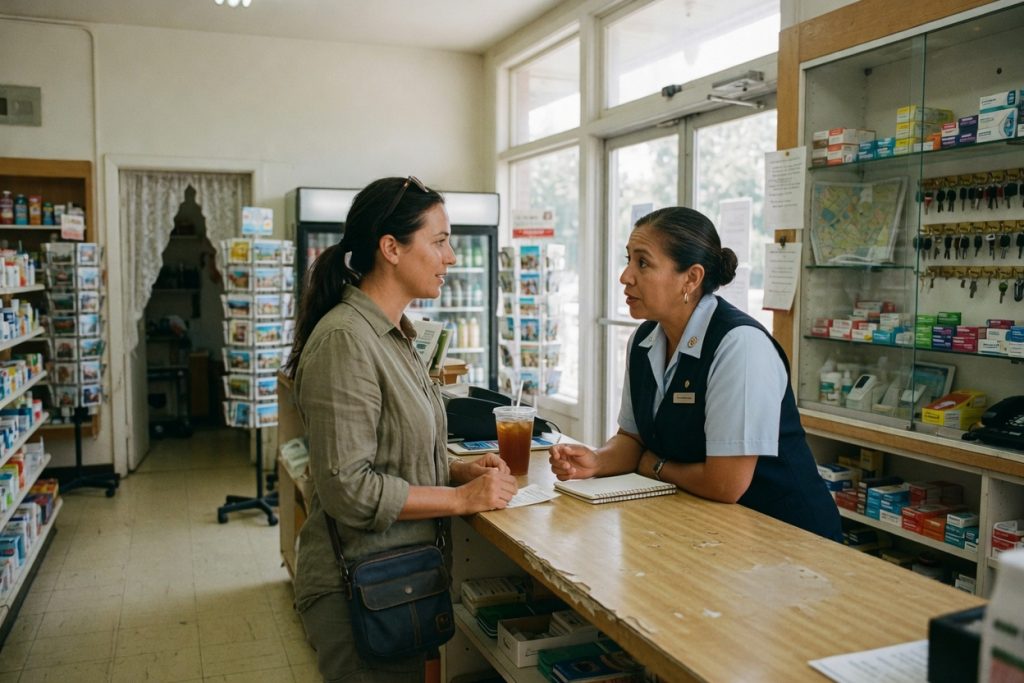
A match who speaks the local language can still be good company. They can tell you what a dish is called. They cannot be the only person who knows what you ordered. Pointing is complete communication. So is “that one.” Warmth survives a smaller menu.
Give staff and emergency services a sentence you prepared
Staff are part of the exit, and they need to hear you. “Please talk to me” is on the list because a match who “explains” you can change the plan: a taxi to their apartment, a story that you are unwell and should come upstairs, a claim that you agreed to stay. If you need a server, a station agent, or a hotel desk that is not your own lodging, face that person and use your sentence. RAINN’s safer-dating guidance says you can end a date when you are uncomfortable, and that you do not owe someone your time or politeness when your safety or comfort is at risk. A missing word does not change that. Your exit strategy can be the ordinary version: “I am leaving now,” in the language you saved, then your own way to transit.
The emergency sentence is the same habit with a higher stake. Save the local emergency number on the card from your emergency and consular plan. Add one line you can read aloud: where you are, in the words of that city, and what you need. Name the public venue, not your lodging.
In the European Union, the European Commission’s page on 112 says you can call 112 free of charge from fixed and mobile phones everywhere in the EU. Operators in many countries can answer in the national language and also in English or French. If the caller does not know where they are, the same page says the operator will identify where the caller is physically located and pass that location to the emergency authorities so they can help immediately. “Many countries” is the Commission’s limit on the language point. The location step is conditioned on the caller not knowing where they are. Save the public venue name so you can give it when you do know it.
For any other country, use the emergency number you copied from an official travel page before you landed. U.S. travelers can start with the State Department’s international travel checklist and the destination page it points to, including local laws. British travelers can use FCDO foreign travel advice. Canadian travelers can use Travel Canada’s advisories. Other travelers should use their own government’s current advice. Do not learn the number from a match, and do not make the match the person who places the call while you cannot see the screen.
Your own route home is still yours. “Where is the metro?” and “Please call a taxi” are for you to say. A match who offers a ride because “it is too hard to explain the station” is offering control of the exit. Thank them and use the station. The first travel date guide covers that route. A language gap does not move it.
Illustrative scenario C, the translation staff actually heard: A traveler in Rome tries to leave a first coffee. The match tells the server, in Italian, a different story: that the traveler is tired and will come to an apartment nearby. She does not debate the sentence she cannot fully follow. She uses the line she saved, “I am leaving now,” faces the server, and walks to the metro she already mapped. Dating in Rome can help you pick a public area before you go. It is not a reason to let someone else tell the room what you meant.
Strengthen the plan for women and higher-risk travelers
The same rules apply to every traveler. Women, LGBTQ+ travelers, and anyone who is visibly a visitor often meet the “I’ll translate, I’ll order, I’ll explain you” pattern earlier, because a language gap is an easy way to test whether you will hand over decisions. Gallivanta’s guides on dating safely as a solo female traveler and solo travel safety for women expand the wider context. The language layer is specific:
- Do not confirm that you cannot read the city, that you are traveling alone, or that this match is your only local speaker. “I keep a simple public plan” is enough.
- Keep the meetup inside your daylight window, at a staffed place, on your own route, as in the travel dating safety overview.
- A private apartment is not a language solution. If you want a quieter conversation, choose another public pin in the same zone.
- If saying a direct no in your second language feels unsafe, move toward staff and use the short line you saved. You do not have to win a debate.
- Your check-in goes to the trusted contact in a language you both already use. The match does not narrate it.
Higher risk changes the margin. It does not change the right to a public plan you can understand. A match who mocks the margin is showing you how they handle a no.
Recognize language and translation red flags
Leave or cancel when the conversation turns into control of your words. Concrete versions:
- Pressure to let them order, pay, or choose a back room because you might misread the menu
- An “English student,” a free tour, or a translation offer that moves the meetup off the public pin
- A request to hold, unlock, or type on your phone, or to open a translation link or QR code
- Anger, teasing, or a safety lecture when you point at the menu or read the bill yourself
- A story told to staff that you did not say, especially one that moves you to a vehicle or a residence
- A plan that only works if you cannot understand the words, the price, or the exit
- A request to translate your check-in, your lodging, or your tickets into the chat
One awkward offer can be a miss. A pattern after a clear answer is the signal. You do not owe a language lesson. The verification checklist includes respect for a boundary. Use it before you are standing outside a room you cannot describe.
The State Department page linked above also describes romance-scam patterns that ask for money, and it says not to send money to someone abroad if you have not met them in person, especially if you met online. The FTC’s romance scam guidance says the same: never send money or gifts to someone you have not met in person. A language gap does not make a hospital bill, a visa fee, or a gift card your problem to solve. Your budget plan covers the coffee. Your emergency plan covers why a stranger’s emergency is not an invoice. This page covers the words. It does not cover funding the story.
Scripts that keep your words without killing warmth
Short lines are easier to send when you are jet-lagged. Adapt the place names. Keep the boundary. You can say them in English in the app. The local-language versions are for the venue.
- The order: “I’ll order my own. The station cafe at 4 works, and I’ll point at the menu if I need to.”
- The phone: “I’ll keep my phone with me. Say the word, and I’ll type it.”
- The link: “I don’t open translation links. I already have what I need for a coffee.”
- The bill: “I read the total myself, and I pay my own share. Then I’m heading to the metro.”
- The exit: “I’m leaving now. This was good.” Use the local line you saved if staff need it.
- The second meet: “I’d like another public hour later this week. Same rule: I order for myself, and we can talk more after that if we both still want to.”
If you want introductions with people who already expect a public first hour, look through Gallivanta’s meet-travelers path. The product does not replace the phrases, the bill, or the decision to speak for yourself.
Travel date language and translation action summary
Run this before you fly, and again before you leave your room.
- Read your government’s country advice for local laws and the emergency number. In the EU, know that 112 is the free emergency number, and that English or French from the operator is something the Commission describes in many countries, not in every call.
- Translate a short list: order, pay your own, bill, leave, metro or taxi, help, police, ambulance, “I do not want that,” and “please talk to me.” Check it twice if you can. Save it without lodging, flights, or door codes.
- On an iPhone, download the Translate language for offline use if Apple lists it as supported. On any other phone, confirm the offline option in that maker’s help. Test it before you agree to a time.
- Share the public pin, the start, and the end in the app, in a language your trusted contact already reads. Do not ask the match to translate that message.
- Decline a borrowed phone, a surprise translation link, and a stranger’s hotspot.
- Order your own item, watch it arrive, and read the itemized total before you pay. Use the alcohol cap and the exit fund you set before you left.
- If someone tells staff a plan you did not make, face the staff and use your leaving line. Then take your own route.
- If you are threatened or hurt, call the local emergency number. Do not hand the phone over so someone else can “call for you.”
- If someone presses after a clear no, end the plan. You do not owe a second explanation in either language.
Then go have the hour. A small vocabulary and a public pin can exist on the same afternoon. That is the whole plan.
Sources, facts, and review boundaries
This guide is practical planning for solo travelers arranging short public meetups. It is not legal advice, interpretation, threat assessment, or a guarantee of safety. Emergency-operator languages, translation features, menus, and local laws vary by country and phone, and they change. Verify the emergency number, your government’s travel advice, and your phone’s offline translation before you meet.
The images in this package are illustrations created for this Gallivanta article. They are not photographs of a real meetup or a real traveler.
Gallivanta encourages traveler control, public-first first meetings, and proportionate boundaries. No checklist can certify another person’s intent. Use this plan so adventure and connection remain choices you can revise. Editorial standards for how Gallivanta separates reporting, composites, and product mentions are on the editorial standards page and the why trust us page.
Official guidance worth reading before you treat “I’ll translate” as only polite:
- European Commission: 112, the EU emergency phone number
- U.S. Department of State: Scams, including the teahouse, restaurant, or bar pattern
- U.S. Department of State: International travel checklist
- UK Foreign, Commonwealth & Development Office: Foreign travel advice
- Government of Canada: Travel advice and advisories
- Apple: Translate words and phrases on iPhone
- RAINN: Tips for safer dating, online and in person
If you are in immediate danger, contact local emergency services. Platform reporting and official consumer reporting channels matter after you are safe. The State Department scam page points U.S. victims toward the FTC and the FBI’s IC3.
Editorial review date: October 16, 2026.
FAQ: travel date language and translation
Should I let a travel date translate for me?
No. A public pin, a time, and a few phrases you prepared are enough for a first meetup. A match can suggest a place and can tell you what a dish is called. They do not need to order, read the bill, or explain you to staff. If you want help with a word, they can say it out loud while you type.
What phrases should I save before a first meetup?
Save lines you will actually use: ordering your own drink, paying your own share, asking for the bill, saying you are leaving, asking for the metro or a taxi, and one plain sentence for help, the police, or an ambulance. Translate them before you fly, check them while you still have time, and keep your lodging and tickets out of that note.
Is a translation app enough?
It can help with a menu word. It does not replace the phrases you saved, and it does not need to be a link someone else sent. On an iPhone, Apple’s Translate guide says you can download supported languages and translate on the phone without an internet connection. Confirm that download before you fly. On any other phone, confirm the offline option in the maker’s own help. Use data you tested before you left your room.
What if I do not speak the local language at all?
You can still meet. Pick a staffed public place, bring the phrases, and use a translator you installed yourself. In the EU, 112 reaches emergency services free of charge, and the European Commission says operators in many countries can answer in the national language and also in English or French. That is not a promise for every call, and it is not a promise outside the EU. Save the local emergency number and one plain sentence before you agree to the meetup.
What if they ask to type on my phone?
Decline. The phone stays in your hand. They can say the word out loud, or you can type it yourself. A request to hold the phone, unlock it, or open a link “for the translation” is a phone problem as well as a language problem. Leave if the request continues after a clear no.
What if the menu or the bill does not match what they said?
Do not pay before you have read the itemized total. If it does not match what you ordered, ask staff, the manager, or local police to help resolve it, and avoid escalating. The U.S. State Department describes a restaurant and bar pattern in which someone offers to show you around, the menu is hard to read, and the bill is far larger than you expected. If you are threatened, leave if you can and call the local emergency number.

Fact-checked | Safety reviewed | Updated October 16, 2026
Ready to Meet Your Next Travel Date?
You've got the destination, the vibe, and the courage to go solo. Now all you need is someone who gets it. Join Gallivanta and meet fellow travelers who believe the best chapters start with a one-way ticket.
Join Gallivanta Free