
Your Next Adventure Could Change Everything
Join thousands of adventurous women who've discovered that the best travel stories often include a plot twist.
Start Your Adventure – Join Free
✓ Free to join ✓ No credit card required ✓ Join 50,000+ travelers
A travel date daylight window plan is a time-bounded meetup design that keeps a first in-person connection inside bright, staffed, public hours in a city that is not your permanent home. It does not prove a match is safe, kind, or compatible. It reduces avoidable risk that comes from darkness, empty streets, tired judgment, and transit options that shrink after sunset.
Gallivanta’s travel-first position is adventure first, sparks welcome, traveler control intact. After verification, a public meeting point, independent transport, and a check-in protocol, daylight is the schedule layer that keeps those controls usable. A great conversation that drifts past your exit into an unlit transfer is not romance. It is logistics failure dressed as chemistry.
Published and reviewed: September 16, 2026
- → Why daylight windows matter
- → Define your usable daylight
- → Build arrival and exit buffers
- → Choose venues that stay staffed
- → Set a hard stop before dark
- → Pair with backup and check-in plans
- → Adapt for latitude and season
- → Recognize daylight pressure tactics
- → Use calm daylight scripts
- → Run the action checklist
- → Review sources and boundaries
- → Read the FAQ
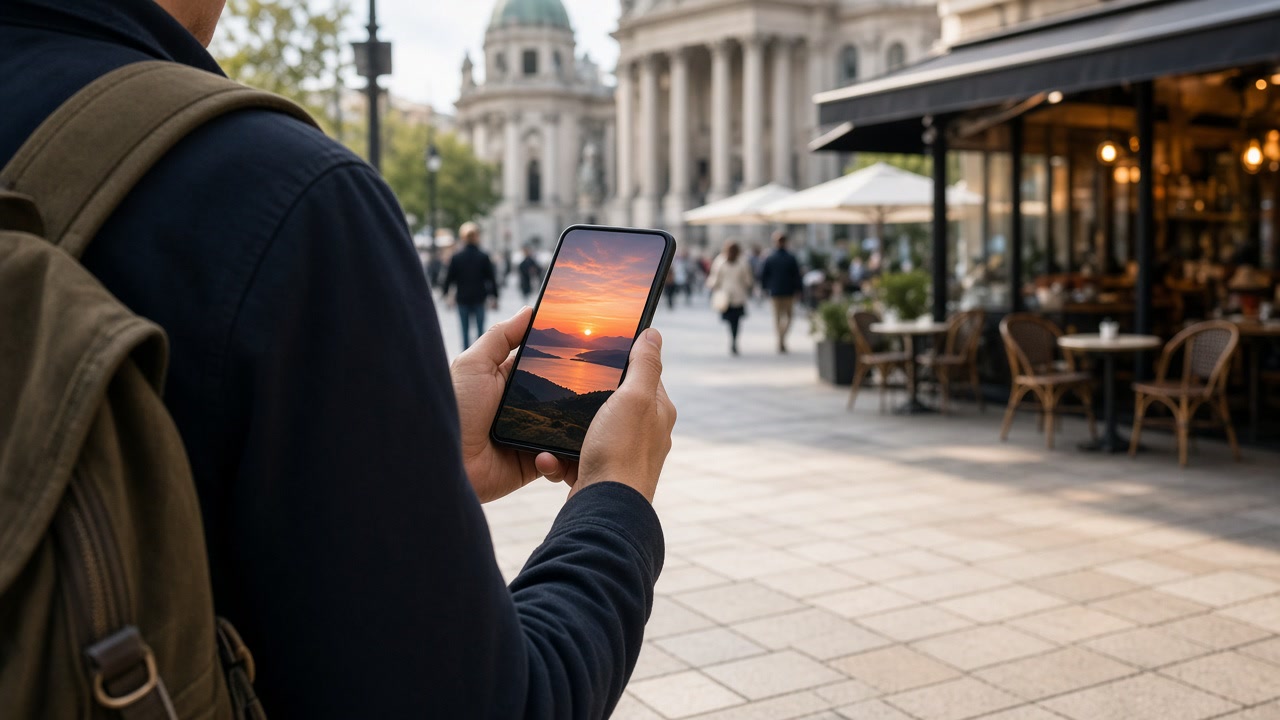
Why daylight windows matter on a first travel date
First travel dates compress unfamiliar geography into a short public hour. You may not know which blocks feel empty after dusk, which bus lines thin out, or which cafe terraces lose staff at shift change. Daylight does not make someone trustworthy. It keeps your own systems working: visible staff, easier self-navigation, clearer photos for a trusted contact if needed, and less pressure to accept a ride “just to get you home safely.”
This layer sits beside—not instead of—your travel date verification checklist, your meeting-point plan, your check-in protocol, and your exit strategy.
Keep four truths separate. Facts are sunset times, venue hours, and transit last-runs you can verify. Examples are illustrative composites for teaching, not testimonials. Assumptions are personal risk tolerances that differ by traveler and neighborhood. Advice here is operational hygiene for a short public meetup, not a guarantee of safety and not a substitute for local emergency services.
Consumer and travel-safety guidance repeatedly warns that romance and travel contexts attract rushed private meetings, money pressure, and social-engineering tactics. A daylight window does not solve those threats alone. It keeps the meetup inside conditions where leaving is still ordinary, public, and independently possible—consistent with Gallivanta’s pre-landing safety plan and public-first norms.
Define your usable daylight, not just the astronomical sunset
Usable daylight for a first travel date is shorter than the clock sunset. Subtract the minutes you need to walk to a lit transfer, wait for a rideshare in a staffed pin, or return to lodging before the neighborhood empties. In winter mid-latitudes that can mean ending the meetup ninety minutes before official sunset. Near the equator, “golden hour” still matters because outdoor plazas can empty quickly after dinner rush.
Before you confirm a time with a match, write three numbers:
- Local sunset (or end of civil twilight if you understand that distinction).
- Your latest leave-seat time.
- Your latest arrive-lodging time with a realistic transit buffer.
Those numbers belong in the same note as your venue name and check-in cadence. If you cannot state them, you do not have a daylight plan yet. You have a hope that “afternoon” will stay bright enough.
Travelers who use Gallivanta to find travel-first connections still own this schedule layer offline. Platform chat can propose a cafe. Your daylight math decides whether that cafe hour is actually leaveable.
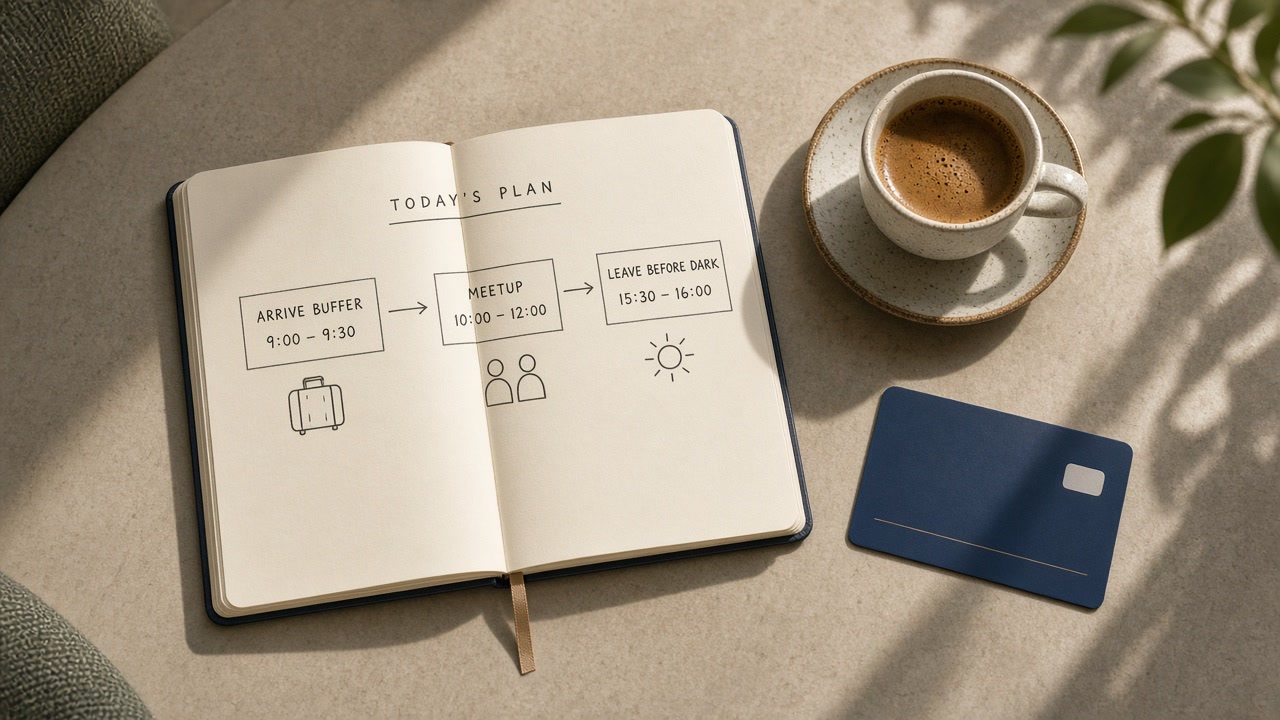
Build arrival and exit buffers that protect the window
A daylight window fails when you spend the bright hour getting lost. Arrive early enough to find the entrance, confirm staffed seating, and send your Arrive check-in without rushing across traffic. Exit early enough that “one more drink” does not push you into a dark transfer you did not budget.
A practical pattern for a sixty- to ninety-minute first meet:
- Scout buffer: 10–20 minutes before the match arrives, or before you sit if you arrive second.
- Meetup block: the social hour itself, capped on your calendar.
- Leave buffer: standing, paying, and walking to your independent route while light remains usable.
- Transit buffer: waiting, boarding, and the walk from stop to lodging door.
Put the leave-seat alarm on your phone. Chemistry is exactly when memory fails. Align the buffers with your backup plan so a venue change does not steal your daylight by accident.
Illustrative scenario A — The sunset that looked fine on paper: Alex books a 5:30 cafe meet in a city where sunset is 6:40. Without buffers, leaving at 6:35 means a 25-minute walk through a park edge that empties early. With a daylight plan, Alex sets leave-seat at 6:05, Arrive/Mid/Leave check-ins, and a hard stop spoken up front. The conversation can continue another day. The transfer does not have to.
Choose venues that stay staffed through your whole window
Daylight is not only sky brightness. It is whether the place still has people who work there when you need to leave. Prefer cafes, museum cafes, busy food halls, and well-trafficked plazas with visible staff or steady public flow during your exact hour. Avoid “meet at the viewpoint after the tour buses leave” for a first travel date.
Check three venue facts before you confirm:
- Opening and closing times for your date, not yesterday’s blog post.
- Whether outdoor seating remains supervised or becomes an empty terrace.
- Whether your independent return route stays lit and frequent through your leave buffer.
Pair venue choice with your first travel date planning guide and location privacy habits from the location sharing plan. A beautiful overlook that requires a dark hillside walk home is a photography idea, not a first-meet design.

Set a hard stop before dark and say it without apology
A hard stop is a spoken end time you choose before chemistry starts negotiating. It is not hostility. It is the same courtesy as a calendar hold. State it early: “I can do until 5:15, then I have a hard stop.” If the match treats a time boundary as disrespect, you have compatibility data before nightfall complicates the exit.
Do not trade the hard stop for vague extensions (“we’ll see how we feel”). Extensions are how daylight plans die. If both people want more time, schedule a second public meetup on another daylight window after you are back at lodging and thinking clearly.
Loving This Travel Dating Safety? Don't Explore It Alone.
Real Gallivanta members are planning trips to Travel Dating Safety right now. Join the community and turn your solo travel dreams into shared adventures.
Join Gallivanta FreeIf you prefer travel-first product tooling for meeting travelers who already expect public-first norms, you can explore Gallivanta’s meet-travelers path while keeping daylight math and check-ins offline with your own contact.
Illustrative scenario B — Hard stop that preserved optionality: Priya tells her match she can meet 3:00–4:20 at a staffed bakery. At 4:15 she stands, sends Leave, and takes her own tram. They book a second daylight coffee two days later. Nobody needed a night walk to prove interest.
Pair the daylight window with backup and check-in plans
A daylight window collapses if the cafe is closed, full, or suddenly hosting a private event. Your backup venue must also fit the same daylight math, not “somewhere nearby later.” Keep the backup within a short walk and still inside your leave-seat deadline.
Your check-in protocol should reference the daylight hard stop. Mid-window and Leave windows are easier to honor when they align with an alarm tied to sunset buffers. Silence after grace still means fail-closed action with your trusted contact, not improvisation.
Independent transport remains non-negotiable. Daylight does not make sharing a stranger’s scooter wise. Keep your own ticket, route, and exit under your control, the same principle behind transportation independence and public-first meetups.
Adapt for latitude, season, jet lag, and local rhythm
Summer at high latitude can tempt endless golden evenings. That light is real and still not a reason to skip buffers if your lodging area empties or if you are decision-fatigued from travel. Winter at mid-latitude may force late-morning or early-afternoon meets only. Near polar shoulder seasons, civil twilight can be long; still prefer staffed spaces and independent exits.
Jet lag is a daylight enemy. If you landed at dawn and feel falsely alert at 4 p.m., shorten the meetup. Tired travelers accept rides, skip check-ins, and miss last trains. Build the window for the traveler you will be at meetup time, not the traveler you imagined on the flight.
Women traveling alone, LGBTQ+ travelers in hostile legal environments, disabled travelers who need predictable exits, and anyone facing language barriers may need earlier hard stops or denser check-ins. Risk is not evenly distributed. Strengthen the plan; do not outsource judgment to the match.
Illustrative scenario C — Jet-lag compressed window: Sam lands at 6 a.m., naps poorly, and is invited to a 7 p.m. “quick drink.” Sunset is 7:10. Sam counters with a 2:30–3:40 museum cafe window the next day instead. The match who only wants night isolation is filtered out by schedule before any private street is involved.
Recognize daylight pressure tactics and schedule red flags
Stop or downgrade when you see patterns like:
- Push to move the first meet after dark “because that is when the city is alive.”
- Mockery of your hard stop, buffers, or need to message a trusted contact.
- Last-minute venue changes to isolated viewpoints, parked cars, or unmarked entrances.
- Requests for money, crypto, gift cards, passport scans, or booking takeovers—classic romance-scam patterns highlighted by consumer-protection agencies.
- Pressure to abandon independent transport because “it will be dark and I will drive you.”
A daylight plan is not paranoia theater. If you feel you must hide your end time to keep peace, the meetup design is already wrong. Return to public-first planning and, if needed, cancel. For broader framing, see Gallivanta’s overview on whether travel dating can be approached safely.
Scripts that keep the daylight window calm
Use short scripts that do not overshare and do not apologize for having a life:
- To the match (propose): “I can do a daylight cafe tomorrow 3:00–4:15. Public spot near the tram.”
- To the match (hard stop): “I have a hard stop at 4:15—I’ve got to head back before it gets dim on my route.”
- To the match (decline night shift): “I’m keeping first meets in daylight. If we both want round two, we can set another afternoon.”
- To your contact (Before): “Bakery Lumen, 3:00–4:15 leave-seat. Sunset buffer on. Mid code 🟡.”
- To your contact (Leave): “Leaving on schedule, own tram, home ping after.”
If someone treats basic daylight logistics as disrespect, you do not owe a debate. You owe yourself a leaveable hour.
Travel date daylight window plan: action summary
- ☐ Look up sunset or usable-light end for the meetup city and date.
- ☐ Set leave-seat and arrive-lodging times with transit buffers written down.
- ☐ Choose a staffed public venue whose hours cover the full window plus exit.
- ☐ Confirm a backup venue that still fits the same daylight math.
- ☐ Speak a hard stop early; put Mid and Leave alarms on your phone.
- ☐ Keep independent transport; refuse ride pressure framed as night “help.”
- ☐ Align check-ins with the daylight hard stop and fail-closed grace rules.
- ☐ Shorten the window if jet lag, weather, or neighborhood emptiness raises risk.
- ☐ Exit on time even if chemistry is good; schedule a second daylight meetup later if mutual.
- ☐ After Home ping, note what timing worked so the next city starts from a template.
Sources, facts, and review boundaries
This guide synthesizes operational practices for solo travelers with publicly available safety guidance. It does not claim firsthand testing of every city venue, does not invent traveler testimonials, and does not present illustrative scenarios as real people. Romance-scam and communication-abroad guidance from consumer-protection and foreign-travel authorities remains essential reading when money, documents, or isolation pressure appears.
Primary references consulted for framing:
- U.S. FTC — What to know about romance scams
- U.S. State Department — Communication abroad
- RAINN — Safety tips for online dating
- U.S. State Department — Scams
If you are in immediate danger, contact local emergency services. Platform reporting and official consumer reporting channels matter after you are safe. Editorial review date: September 16, 2026.
FAQ: Travel date daylight window plan
Does a daylight window make a travel date safe?
No. It keeps the meetup inside brighter, more staffed conditions where leaving stays ordinary. It cannot prove intent, eliminate crime, or replace local emergency help.
How long should a first daylight meetup be?
Many solo travelers start with 60–90 minutes plus arrival and exit buffers, ending early enough that the return route stays usable. Adjust for city, season, and energy—not for guilt.
What if sunset is very early in winter?
Shift to late morning or early afternoon, shorten the social block, and keep the hard stop. Do not “make up for short days” by accepting an isolated night first meet.
Can we continue after dark if the area is busy?
Busy nightlife is not the same as a controlled first-meet design. Prefer scheduling a second daylight meetup. If you ever extend, keep the place staffed, public, and independently leaveable—and update your trusted contact.
What if a match insists on night-only plans?
Treat night-only insistence for a first meet as a filter. Offer a daylight alternative once. If they refuse, decline. You are selecting logistics, not negotiating your right to a leaveable hour.
How does this fit with a check-in protocol?
Use the same Before/Arrive/Mid/Leave/Home cadence, with Mid and Leave alarms tied to your daylight hard stop. Fail-closed rules still apply if a window is missed after grace.

Fact-checked | Safety reviewed | Updated September 16, 2026
Ready to Meet Your Next Travel Date?
You've got the destination, the vibe, and the courage to go solo. Now all you need is someone who gets it. Join Gallivanta and meet fellow travelers who believe the best chapters start with a one-way ticket.
Join Gallivanta Free