
Your Next Adventure Could Change Everything
Join thousands of adventurous women who've discovered that the best travel stories often include a plot twist.
Start Your Adventure. Join Free
✓ Free to join ✓ No credit card required ✓ Join 50,000+ travelers
A travel date plus-one plan is the decision you make, before you leave your lodging, about who is allowed to be in the hour. You agreed to one person. A friend, a cousin, a driver, or a local guide who appears beside them is a new plan. You can decline it without turning the meetup into a scene.
Gallivanta’s travel-first position is adventure first, sparks welcome, traveler control intact. Your meeting point already names a staffed public pin. Your household boundary plan keeps the people who live with you out of a visit. This page is the other side of that door. Their people do not get a seat just because the messages have been warm.
Published and reviewed: November 5, 2026
This plan sits beside your verification checklist, your transportation independence plan, your daylight window, your check-in protocol, and your backup plan. Verification asked whether the person matches the story. A plus-one plan asks a narrower question: is the person in front of you the only person you agreed to meet?
Keep four truths separate. Facts are what official pages say about public meetings, about telling a trusted person the plan, and about money requests tied to a visit. Those pages are cited below. Examples are illustrative composites for teaching, not testimonials and not reports about real friends or real drivers. Assumptions are personal risk tolerances that differ by city, by how well you know this person, and by whether you are alone in the country. Advice here is operational hygiene for a short public meetup. It is not a guarantee of safety, not legal advice, and not a substitute for local emergency services.
- → Why a plus-one is a different problem
- → Agree the guest list before you leave
- → A friend, a cousin, or a group
- → A driver and a local guide
- → If they are already there
- → Leave on the route you already chose
- → Names, photos, and the group chat
- → Tighten the plan when the stakes are higher
- → Recognize plus-one red flags
- → Use calm scripts
- → Run the action checklist
- → Review sources and boundaries
- → Read the FAQ
Why a plus-one is a different problem
A first meetup is a small agreement. One pin. One window of time. One other person. The rest of the travel-date series protects the place, the hour, the money, the phone, and the door. None of those controls survive a quiet change in headcount. Two extra people at a cafe are still a public place. They are not the meeting you planned, and they are not a small manners issue you should absorb.
Other Gallivanta guides mention company in a sentence. The meeting-point page scores a venue for visibility. The backup plan keeps a same-zone fallback when the first pin fails. The household plan says your roommate is not a character witness. None of those pages is the moment a match says, outside the cafe, “I brought my cousin, you will love him.” This page is that moment, decided before you are standing in it.
Courtesy is the costume this problem wears. A friend can be framed as safety, as hospitality, or as a happy accident. “She was already in the neighborhood” is a story. It is also an unagreed audience for your face, your accent, your plans, and the way you say no. You can like the match and still refuse the audience. Liking someone is not a reason to renegotiate the guest list on the sidewalk.
Keep four layers separate. The match is the person you already decided to meet. The plus-one is anyone else who arrives with them, including a driver who never sits down. The pin is the staffed public place you both can find and leave. The exit is your own transit, chosen before you saw the extra person. The match can sit inside the hour. The plus-one does not inherit the hour because refusing them would feel rude.
Agree the guest list before you leave
Say the headcount while you are still in your room, in the channel you already use. “I am meeting you, just you, at the museum cafe at 2.” That sentence is the plan. If they want someone else there, the time to hear it is now, when you can still stay in and choose a different day. A yes to a plus-one is a new agreement. It names the person, it keeps the pin public, and it still lets you leave alone. It is not a shrug on the steps.
| Enough to decide before you leave | A change that waits for a new plan |
|---|---|
| One named person, one staffed pin, one end time | “My friend is coming, it will be more fun” |
| Your own transit there and back, already chosen | A car, a driver, or a ride you did not book |
| A trusted contact who knows the pin, the time, and the headcount | Their friend as your safety person |
| A line you will use if the headcount changes | A move to a quieter bar, a home, or a viewpoint |
RAINN’s safer-dating guidance says to let someone you trust know the plan, and to meet in a public place. The plan you send that person includes the headcount. If you told them one name and you arrive to three, message the change before you sit. A trusted contact cannot help you with a plan they do not have. Their cousin is not a substitute for that message.
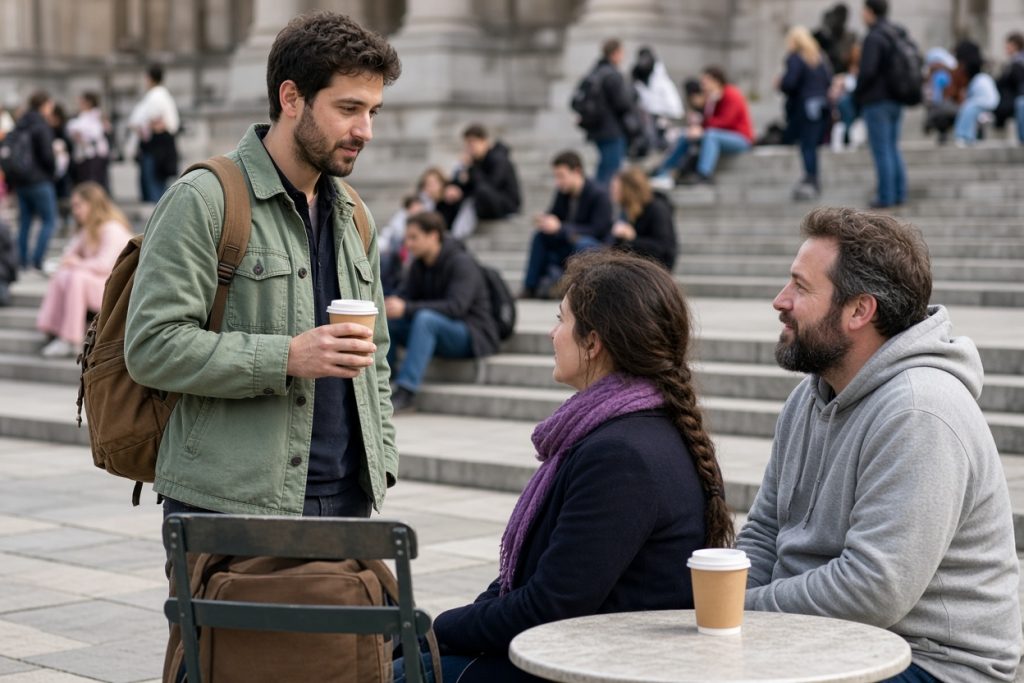
Illustrative scenario A, the second chair: You agreed to one person at a museum cafe. From the steps you see two people already at the table, one of them waving you over as if this were the original plan. With a plus-one plan, you do not sit in order to be easy. You stay on your feet, you use the sentence you wrote in your room, and you leave on the tram you already named. The coffee can happen on a day when the guest list is the one you made.
A friend, a cousin, or a group
A friend can be lovely and still be a plus-one. The question is not whether they seem kind. The question is whether you agreed to meet them, in this hour, at this pin. “You will like her” is a prediction. It is not consent. You can meet that friend another day, in another public place, after you have had the hour you already designed. You do not have to collect the group in order to deserve the match.
A cousin, a roommate, a coworker, or “the people I am traveling with” is the same structure with a family word attached. Family language makes refusal sound cold. It is still your hour. If they want you to meet the people they travel with, that is a group plan, made in advance, with a pin that can hold a group and an exit that is still yours. It is not a surprise at a two-top.
A group also changes what you reveal. One person can forget a detail. Three people remember your hotel neighborhood, your next train, and the way you flinched. Your personal info boundary and your itinerary privacy plan still apply, and they apply to every person at the table, including the quiet one. You do not owe the group your checkout time in order to seem open.
If you do want a group, say so before you leave, and keep the shape. Daylight. A staffed room. Separate checks if you are paying. An end time. No after-party that moves to an apartment “because the group is having fun.” Fun is not a venue change. Your solo date ideas page already leaves private rooms and unplanned walks off the first hour. A group does not put them back on.
A driver and a local guide
A driver is a plus-one even when he stays outside. The person holding the door has your route, your hesitation, and a reason to follow. “He is just dropping me off” can be true and still be a change. You did not agree to be collected. Your transportation plan keeps the ride in your name: your tram, your taxi, your walk from a stop you chose. Their friend’s sedan is a different product.
A local guide is a role change, not a kindness. “Let me show you the real city” stretches a one-hour pin into a day you did not plan, often with a car, a viewpoint, and a stop that is hard to leave. The daylight window exists so the hour ends while you can still see the exit. A tour that outruns that window is not a better date. It is a longer time with someone who knows the streets and you do not.
Decline the tour without prosecuting the offer. “I kept this to one hour at the cafe. I am going to stay with that.” If the next sentence is a friend’s apartment, a rooftop with no staff, or a beach after dark, you are done. Your accommodation privacy plan keeps your own room off the thread. It also means you do not go to theirs, or to their friend’s, to be polite.
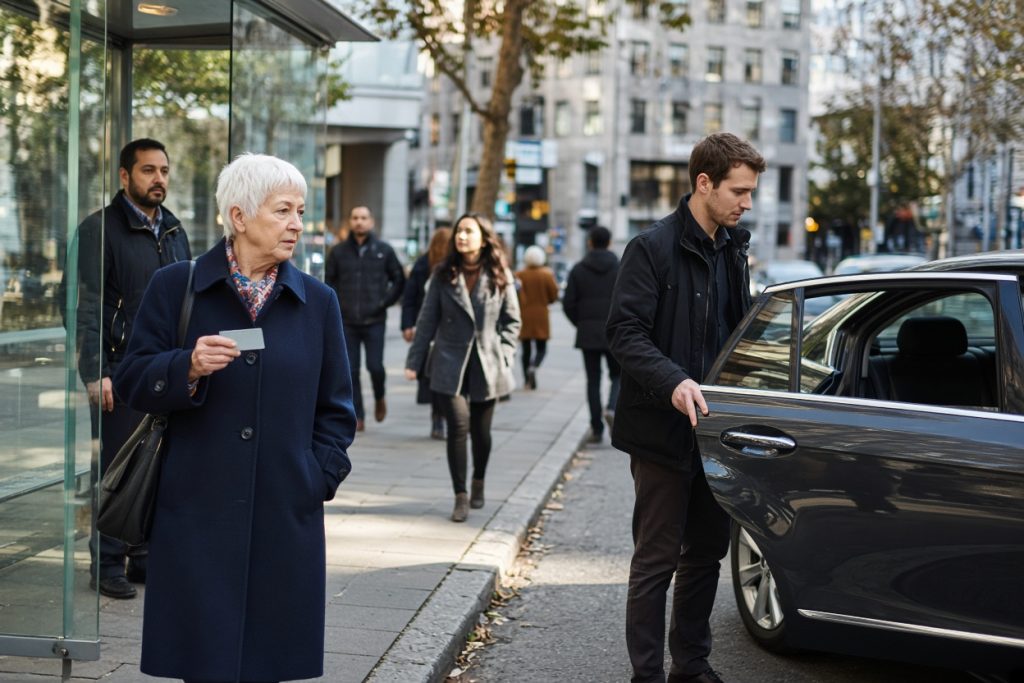
Illustrative scenario B, the view and the car: The coffee is ordinary and fine. Then a message arrives from a cousin who is “downstairs with the car so we can see the view before dark.” With this plan, the view waits. You pay for your own cup, you leave the match at the pin, and you walk to the stop you named that morning. You do not get in to avoid an awkward minute. An awkward minute is cheaper than a car you did not choose.
If they are already there
You can turn around before you sit. Arrival is not a contract. If you are already in the chair when you understand the headcount, you can still leave after you have said one sentence. You do not need a long reason. “I planned this for two. I am going to go.” Then you go. Explaining your whole safety model to a group is how you stay.
Tell your trusted contact the truth in a short message. “Three people, not one. I am leaving.” That message is the check-in, updated. If you had a code word for a missed reply, you do not need to invent a new one on the steps. Use the cue you already agreed. Your check-in protocol was built for the plan. A headcount change is one of the things it is for.
Do not repair the surprise by moving. A quieter bar, a walk, a friend’s place, or “somewhere we can actually talk” is the plus-one asking the room to shrink. Public and staffed was the point. If the group wants a private conversation, they can have it without you. Your reporting plan is for later, if contact continues after you have left. It is not a speech you owe them before you reach the door.
If someone follows you off the pin, treat that as the exit problem it is. Stay where staff and other people are. Do not lead anyone toward your lodging. Use your local emergency number if you believe you are being followed or you are not free to leave. In the United States that number is 911. The number where you are may be different, which is why your emergency and consular plan is saved before this hour, not during it.
Leave on the route you already chose
The plus-one fails most often at the end, when everyone is being nice. “We will drop you.” “It is on our way.” “Get in, we are all going the same direction.” Your direction was chosen so you would not need them. Take it. A shared ride with a person you did not agree to meet is a new meetup, in a smaller room, with the doors controlled by someone else.
Buy your own order, on your own card or your own cash. Do not split a bill you did not plan with people you did not invite. Do not pay their fare, their friend’s ticket, or the car. The U.S. Federal Trade Commission describes romance scams that start with a social approach and then ask for money, including a plane ticket to visit you. It says never to send cash, gift cards, wire transfers, or cryptocurrency to an online love interest. A friend at the table does not make that transfer safer. Your budget plan still has you pay your own way.
Loving This Travel Dating Safety? Don't Explore It Alone.
Real Gallivanta members are planning trips to Travel Dating Safety right now. Join the community and turn your solo travel dreams into shared adventures.
Join Gallivanta FreeThe FBI’s romance-scam guidance says never to send money to anyone you have only communicated with online or by phone. A first public hour is not a deep acquaintance, and a plus-one you just met is less than that. If the group frames a payment as manners, urgency, or a shared adventure, keep your money in your account. You can be warm with empty hands.

Names, photos, and the group chat
A plus-one collects names. Yours, your hotel’s neighborhood, your friend’s name if you mention a check-in, the coworker you should not have named. Give the group less, not more, because there are more ears. “I am here through the weekend” is already more itinerary than a first hour needs. A role is enough if you mention work at all. Your personal info boundary was written for one match. Use it as if everyone at the table is the match.
Photos follow your photo privacy plan, and they follow it for a group shot too. A picture “so the cousin can see who you are” is a portrait you did not agree to hand to a person who was not in the original channel. Decline the photo. Decline the story sticker. You can stand in a public plaza without becoming a post. A no to the camera is not a no to the person. It is a no to the file.
The channel stays the one you already use. Your message channel plan keeps the thread off your private number. A group chat that adds their friend, their cousin, and a driver is a new room with new people and a long memory. Do not join it in order to seem flexible. If they need to change the time, they can do it in the original thread, with the original headcount. A new chat is how a plus-one becomes permanent.
Do not hand them your trusted contact, and do not accept theirs as yours. “Text my friend if you get lost” puts your whereabouts in the plus-one’s phone. Your contact is the person you chose before you left. If you are late or you leave early, that person hears it from you. The State Department’s travel-scam guidance is a reminder that a friendly local arrangement can still be a setup. You do not need to accuse anyone to keep the message path short.
Tighten the plan when the stakes are higher
Women, and anyone traveling alone in a city they do not know, can keep the same rules and make them stricter. One person. One staffed pin you have already looked at on a map. Daylight. Your own transit both ways. No car. No guide. No second location. A shorter hour, not a longer one, if the messages have pushed for extra company. A tighter plan is not a judgment of the match. It is a match for the fact that you cannot read a group as fast as you can read one face.
If you are the local and they are the visitor, the pressure runs the other way. You know the streets, so a plus-one can be framed as you being unfriendly to their travel companions. You are allowed to be a precise host. One public hour is generous. A tour of your neighborhood, an introduction to your friends, or a seat in your car is a different offer, made later if you want it. Your home city visit plan already keeps their hotel in their name. This plan keeps their companions out of your passenger seat.
If alcohol is in the hour, your alcohol boundary still caps the drinks, and a group does not raise the cap. You do not leave a drink to talk to the extra person. You do not accept a round you did not watch. The point of a staffed cafe is that you can end the hour on a coffee. A group that needs a second venue and a second round is asking for a party. Parties can be planned. They are not the repair for a broken guest list.
Recognize plus-one red flags
One of these can be clumsiness. Two are a pattern. You do not need the pattern to leave. Any one of them is enough to keep the original plan or to end the hour.
- They mention the friend only after you have left your lodging, or only when you can see the friend.
- The extra person is the one with the car, the cash, or the plan for the next stop.
- They want the pin moved to a home, a hotel room, or a bar they describe as quieter.
- They ask you to pay a fare, a ticket, a gift, or a shared bill for someone you did not invite.
- They want a photo or a story that includes you before you have agreed.
- They add you to a group chat with people you have not met.
- They treat your no as an insult, a joke, or a test of whether you are fun.
- They follow, or they send the plus-one to follow, when you leave the pin.
A red flag is not a debate topic. You do not owe a group a cross-examination. You owe yourself the exit you already wrote down. If the contact continues after you are safe, use the reporting plan. If you are in immediate danger, use local emergency services first. Platform tools and a report to the FTC come after you are safe.
Use calm scripts
Write these in your own notes before you go. Say the short version. Do not add a life story to soften them. A long apology is how you stay for the tour.
- “I planned this hour for the two of us. I am going to keep it that way.”
- “I am glad they are in town. I am not adding a person I did not agree to meet.”
- “I am not getting in the car. I will take the transit I already planned.”
- “We can end here. I am not moving this somewhere private so the group can talk.”
- “I buy my own coffee. I do not send money for someone else’s fare.”
- “I do not do group photos on a first meetup. We can skip the picture.”
If they mock the script, the script worked. You learned that your boundary is entertainment to them. Leave. You can be proud of a short sentence. You do not have to win the table.
Run the action checklist
Do this before you leave your lodging, and again when you see the pin. If a line fails, you stay in or you leave. You do not patch it with politeness.
- Name one person in the original channel. If they want someone else, decide before you go, or do not go.
- Send your trusted contact the pin, the time, the end time, and the headcount of one.
- Choose your transit both ways. Do not leave a gap that their car is meant to fill.
- Keep the pin staffed and public. Keep the hour inside your daylight window.
- On arrival, count the people. If the count is wrong, use your sentence and leave, or stay only with the person you named if the extra person actually goes.
- Pay for your own order. Do not fund a fare, a gift, or a friend’s ticket.
- No photo, no group chat, no second location, no guide for the rest of the day.
- Leave on your own route. Message your contact when you are clear of the pin.
- If you are followed or you cannot leave, use local emergency services. Report after you are safe.
Travelers who coordinate on Gallivanta can keep the first yes inside a channel that is not a group chat with strangers. The product can hold a pin and a time. It cannot notice that a kind hour became three people and a car. That notice is the plan. People who use Gallivanta to meet travelers can keep the same split on the road: a public pin is a plan, and a plus-one is a new plan.
Sources, facts, and review boundaries
This guide is practical planning for people who are considering a first public meetup with someone they met while traveling or online. It is not legal advice, threat assessment, or a guarantee of safety. Emergency numbers and platform tools vary, and they change. Verify your local emergency number before you need it.
The images in this package are illustrations created for this Gallivanta article. They are not photographs of a real meetup or a real group.
Gallivanta encourages traveler control, public-first meetings, and proportionate boundaries. No checklist can certify another person’s intent, or the intent of the person they brought. Use this plan so a meetup stays the size you agreed to. Editorial standards for how Gallivanta separates reporting, composites, and product mentions are on the editorial standards page and the why trust us page.
Official guidance worth reading before you agree to extra company:
- U.S. Federal Trade Commission: Romance scams. The FTC describes contacts that turn into requests for money, including a plane ticket to visit you, and it says never to send cash, gift cards, wire transfers, or cryptocurrency to an online love interest.
- RAINN: Tips for safer dating, online and in person. RAINN’s guidance includes meeting in public, arranging your own transportation, and telling a trusted person the plan.
- U.S. Department of State: Scams.
- FBI: Romance scams. The FBI says never to send money to anyone you have only communicated with online or by phone.
If you are in immediate danger, contact local emergency services. In the United States that is 911. Platform reporting and the FTC’s ReportFraud.ftc.gov channel matter after you are safe. If you are harmed or assaulted, RAINN’s National Sexual Assault Hotline is available at 800-656-HOPE (4673), and RAINN says you can also reach it by chat at rainn.org. That harm is not your fault, and it is not a reason you failed this plan. Safety first, then the report.
Editorial review date: November 5, 2026.
FAQ: travel date plus-one plan
Do I have to stay if they brought a friend?
No. A plus-one you did not agree to is a new plan, and you can decline it in the moment. Thank them, keep the hour at the public pin if you still want the one person you agreed to meet and the extra person leaves, or leave on your own transit. You do not owe a group a rewritten afternoon. RAINN’s safer-dating guidance is to meet in public and to tell a trusted person the plan you actually have, not the plan that changed at the table.
Is a cousin or a local friend a reasonable safety chaperone?
Only if you agreed to that person before you left your lodging, and only if they are not replacing your own exit. Their friend is not your check-in contact. Your check-in protocol still uses someone you chose. A surprise chaperone is still an extra person with eyes on your face, your route, and your reaction.
Should I get in their friend’s car if the cafe is closing?
No. Your transportation independence plan keeps the ride in your name. A sedan at the curb, driven by someone you did not agree to meet, is a change of venue and a change of company. Walk to the transit you already picked. The FTC’s romance-scam guidance says never to send cash, gift cards, wire transfers, or cryptocurrency to an online love interest, including when the story is a plane ticket. The ride itself is a separate no, even when nobody asks you for money.
What if the plus-one is already seated when I arrive?
You can turn around before you sit. If you sit, you can still leave after one drink you bought yourself, or with no drink. Tell your trusted contact that the headcount changed. Do not move the pin to somewhere quieter so the group can talk. Quiet is how a public hour stops being public.
Can I pay for the friend’s coffee to be polite?
Pay for your own order. Do not pay their fare, their friend’s ticket, or a shared bill you did not plan. The FTC describes a request for a plane ticket to visit you, and it says never to send cash, gift cards, wire transfers, or cryptocurrency to an online love interest. A friend at the table does not make a transfer safer. Your budget plan still applies.
What if they want to guide me for the rest of the day?
A guide is a different job from a one-hour public meetup. Decline the rest of the day when you have not planned it. Keep the meeting point, the daylight window, and your own route. A tour that includes their apartment, a friend’s apartment, or a car is not the meetup you agreed to. You can like them and still end at the time you set.

Fact-checked | Safety reviewed | Updated November 5, 2026
Ready to Meet Your Next Travel Date?
You've got the destination, the vibe, and the courage to go solo. Now all you need is someone who gets it. Join Gallivanta and meet fellow travelers who believe the best chapters start with a one-way ticket.
Join Gallivanta Free